JSTOR Global Plants Home
  • Home
  • Browse
  • About
  • Access
  • Account
    • Saved Items
    • Profile
  • Log in

Global Plants

Skip to Main Content
  • JSTOR Global Plants Home
  • Global Plants

    • Browse
    • About
    • Access
    • Account
      • Saved Items
      • Profile
Log in
  • Browse
  • About
  • Access
  • Account
    • Saved Items
    • Profile
Advanced Search

Compilation
Suaeda aegyptiaca

8 Images see all

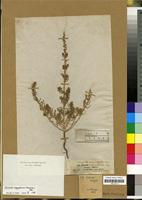
Filed as Suaeda aegyptiaca (Hasselq.) Zohary [family CHENOPODIACEAE]
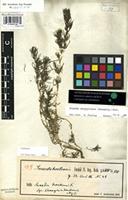
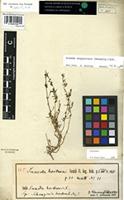
Syntype of Suaeda hortensis Forssk. [family CHENOPODIACEAE]
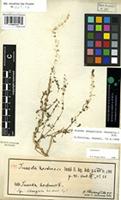
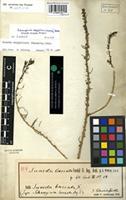
Holotype of Suaeda baccata Forssk. [family CHENOPODIACEAE]
Syntype of Suaeda hortensis Forssk. [family CHENOPODIACEAE]
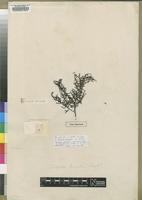
Filed as Suaeda aegyptiaca (Hasselq.) Zohary [family CHENOPODIACEAE]
Type of Suaeda baccata Forssk. [family CHENOPODIACEAE]
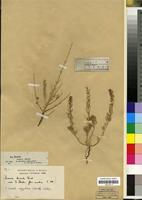
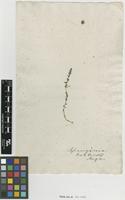
Type? of Suaeda hortensis Forssk. ex J.F.Gmel. [family CHENOPODIACEAE]
Previous
Next

Name

Identification
Suaeda aegyptiaca (Hasselq.) Zohary [family CHENOPODIACEAE ] (stored under name); Verified by H. Freitag, Kassel, 1988 Suaeda baccata Forssk. [family CHENOPODIACEAE ] Verified by G. Schweinfurth and P. Ascherson, 1881 Suaeda fruticosa Forssk. [family CHENOPODIACEAE ] Verified by Not on Sheet, Salsola altissima L. [family CHENOPODIACEAE ] Verified by Not on Sheet, Schanginia baccata Mq. T. [family CHENOPODIACEAE ] Verified by G. Schweinfurth and P. Ascherson, 1881 Schanginia aegyptiaca (Hasselq.) Aellen [family CHENOPODIACEAE ] Verified by D. Hillcoat, 1973
Related name
  • Salsola altissima
  • Suaeda setigera
  • Suaeda baccata
  • Schanginia hortensis
  • Suaeda aegyptiaca
  • Schanginia aegyptiaca
  • Suaeda fruticosa
  • Suaeda hortensis
  • Schanginia baccata

Flora

Entry for SUAEDA aegyptiaca (Hasselq.) Zohary [family CHENOPODIACEAE]
Herbarium
Royal Botanic Gardens, Kew (K)
Collection
Flora Somalia
Resource Type
Reference Sources
Entry From
Flora Somalia, Vol 1, (1993) Author: by I. Friis & M. G. Gilbert [updated by M. Thulin 2008]
Names
SUAEDA aegyptiaca (Hasselq.) Zohary [family CHENOPODIACEAE], (1957);
Chenopodium aegyptiacum Hasselq. [family CHENOPODIACEAE], (1757);. [type as above]
Suaeda baccata Forssk. ex J. F. Gmel. [family CHENOPODIACEAE], (1791), nom. illeg.;. [type as above]
Schanginia aegyptiaca (Hasselq.) Aellen [family ], (1964). [type as above]
Suaeda hortensis J. F. Gmel. [family CHENOPODIACEAE], (1791);
Schanginia hortensis (J. F. Gmel.) Moq. [family ], (1840). [type as above]
Information
Low shrub to 60 cm high, often sprawling, most parts glaucous, often suffused deep pink. Leaves linear to fusiform, terete, tip acute, 12–20 x 1 mm, progressively reduced along flowering stems. Flowers bisexual and female in dense clusters sometimes inserted on base of petiole rather than strictly in the leaf axil and sometimes contiguous into ± interrupted spikes. Bisexual flowers: perianth deeply divided, subglobose, c. 3 mm in diam.; ovary free for part of length, acuminately tapered, stigmas filiform, to 2 mm long. Female flowers smaller, staminode-like appendages minute, ovary ± joined to perianth, styles 3–4. Perianth base enlarged in fruit, upper part of ovary swollen and spongy, sometimes with slight basal constriction in bisexual flowers. Seed orbicular to ovoid, not strongly compressed, 0.9–1.1 x 0.8 mm, glossy, blackish.
Range
S3 Red Sea coasts north into Israel and Egypt.
Altitude range
near sea level.
Distribution
SOMALIA Paoli 276; Powell 8.
Distribution (external)
Djibouti
Notes
The record is based only on the two collections cited above, both from the estuary of the Juba R. One of these collections has been referred to this taxon by Brenan (in herb.) without indication of doubt; however, the very disjunct distribution is unexpected. The status of plants from the Red Sea coast with bright green leaves, usually drying pale, very spongy fruiting perianths with the style base not conspicuously enlarged, and oblique seeds is unclear. They possibly represent a distinct taxon. Glover & Gilliland 906 (N1) may belong with these.

Related Materials

  • Terms and Conditions
  • Privacy Policy
  • Cookie Policy
  • Cookie Settings
  • Accessibility
  • Help
  • Contact Us
  • Facebook
  • Twitter
ITHAKA

JSTOR is part of ITHAKA, a not-for-profit organization helping the academic community use digital technologies to preserve the scholarly record and to advance research and teaching in sustainable ways.

©2000-2026 ITHAKA. All Rights Reserved. JSTOR®, the JSTOR logo, JPASS®, Aluka®, and ITHAKA® are registered trademarks of ITHAKA.

╳