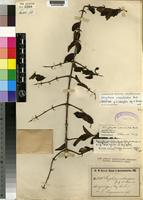
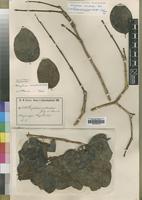
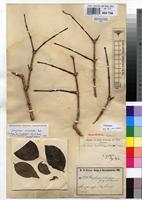
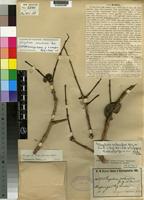
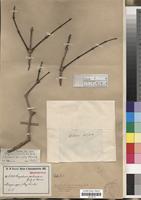
Shrub or small tree 2.5–6.5 m. high or, very rarely, climbing (not spreading), with longitudinally ridged, thick, corky branches; young branchlets often reddish or blackish purple, densely spreading-pubescent or rarely glabrous, usually longitudinally fissured; spines normally present in pairs in the leaf-axils, ± stout, curved at the tip. Leaves shortly petiolate; lamina coriaceous, oblong-elliptic to broadly ovate, usually broadest below the middle, 1.8–8 cm. long, 1.4–6 cm. wide (smaller leaves occurring on burnt or grazed shoots), rounded, acute or rarely emarginate at the apex and sometimes apiculate, rounded, subcordate or rarely cuneate at the base, 3–7-nerved at or just above the base (Fig. 3/3), matt or shining above; venation impressed above, prominent and conspicuous beneath, usually fairly softly pubescent, at least on the nerves; tertiary nerves visible beneath. Cymes terminal, ± dense, usually pubescent (in our area). Calyx-lobes narrowly triangular to linear-lanceolate, about 3 mm. long, pubescent on the back, slightly shorter than or rarely equal to the corolla. Corolla greenish-white; lobes deltoid, about half the length of the corolla-tube, with dense hairs at the base. Stamens inserted near the base of the corolla-tube; anthers densely bearded, longer than the filaments. Ovary ovoid, inconspicuously bilocular; ovules numerous. Fruit globose, 1.6–7 cm. in diameter, with a smooth woody rind, in the fresh state dark green with paler mottlings. Seeds up to 2 cm. across, compressed but neither so flattened nor so numerous as in S. spinosa. Fig. 3/1–6, p. 18.