

Compilation
Strophanthus nicholsonii
1 Images see all
Name
Identification
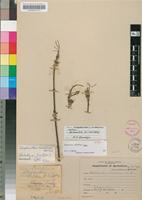
Isotype of Strophanthus nicholsonii Holmes [family APOCYNACEAE ] (stored under name); Verified by Not on sheet,
Related name
- Strophanthus nicholsonii
Flora
Entry for Strophanthus nicholsonii Holmes [family APOCYNACEAE]
Herbarium
Royal Botanic Gardens, Kew (K)
Collection
Flora Zambesiaca
Resource Type
Reference Sources
Entry From
FZ, Vol 7, Part 2, (1985) Author: A. J. M. Leeuwenberg and F. K. Kupicha et al.
Names
Strophanthus nicholsonii Holmes [family APOCYNACEAE], in Pharm. Journ., Ser. 4, 5: 209 (1897). — Stapf in F.T.A. 4, 1: 172 (1902). — White, F.F.N.R.: 352 (1962). — Beentje in Meded. Landb. Wag. 82–4: 113, fig. 30, map 27 (1982). Type: Zambia, between Lusangadzi and upper Luangwa Rs., Nicholson s.n. (PHA, holotype; P, PRE, isotypes).
Information
Shrub, 0·5–2·5 m. high, densely branched, sometimes scandent and up to 6 m. high, deciduous; flowers appearing before or with the leaves; latex clear or orange. Branchlets densely puberulous. Leaves petiolate; petiole 1–2(3) mm. long; lamina medium to dark green above, pale yellowish-green beneath, obovate, rarely almost circular, 1·2–2·5 times as long as wide, 2·5–5·7 x 1·3–3·7 cm., rounded or cuneate at the base, rounded or acute at the apex, papyraceous, densely puberulous above, shortly tomentose beneath, with 4–9 pairs of secondary veins; tertiary venation inconspicuous. Inflorescence l–5(10)-flowered, sessile or pedunculate, densely puberulous in all parts; pedicels 2–7 mm. long; bracts sepal-like. Flowers fragrant. Sepals subequal, linear or narrowly ovate, 4·5–12 x 1·3–3 mm., acute, densely puberulous. Corolla tube 10–19 mm. long and widening at slightly more than 1/2–3/4 of its length into an infundibuliform upper part, at the mouth 5–14 mm. wide, puberulous outside and puberulous or glabrous inside; corona lobes Ungulate, 1–2·5 x 1–1·6 mm., glabrous or minutely papillose; corolla lobes ovate, 4–15 x 3·8–8 mm., narrowing into the pendulous tails; lobes (including the tails) 55–115 mm. long, puberulous outside and glabrous or puberulous inside. Stamens from 1 mm. exserted to 2·1 mm. included; filaments straight, 1–2·3 mm. long; anthers 4–4·8 x 1–1·2 mm., glabrous; acumen 0·1-0·2 mm. long. Ovary 0·8-1·5 x 1·2–1·8 mm. densely pubescent; style 6–10 mm. long; clavuncula 1–1-8 x 0·9–1·3 mm.; stigma minute. Follicles of unknown divergence, long-tapering towards the narrow apex and ending in a small knob or an obtuse apex, 17–28 cm. long and 1·4–2·7 cm. in diam.; exocarp dark brown or purplish-brown, thick and hard, pubescent in young fruits and later glabrescent, fairly densely lenticellate; lenticels elongate. Seeds with the grain 12–22 x 3–5 x 1–1·5 mm., densely pubescent or lanate; rostrum glabrous for 13–44 mm. and bearing a coma for 20–65 m., coma 35–80 mm. long.
Habitat
In mopane woodland
Range
Not known from elsewhere
Altitude range
alt. 400–1100 m
1100
400
Distribution
Zimbabwe E Inyanga N. Res., Gairezi R. bank, x.1958, Davies 2518 (K; PRE; SRGH).Zimbabwe W 15 km. from Mbala Lodge on Hwange (Wankie) road, 22.X.1968, Rushworth 1222 (K; LISC; PRE; SRGH).Zambia S Gwembe, 1. xi.1955, Bainbridge 171/55 (FHO; K; SRGH).Zambia C Katondwe Mission, 13.xi.1966, Fanshawe 9839 (K).Mozambique T Zambezi R., 60 km. W. of Msasa, 10.i.1951, Chase s.n.(MO; NY).Malawi N Mzimba Distr., above Lake Kazuni, 17.x.1973, Pawek 7406 (MO; PRE; UC; WAG).Zimbabwe N Urungwe Distr., Gache-Gache Triangle, 21.xi.1953, Wild 4266a (B; BR; FI; K; MO; PRE; S; SRGH).Zambia E 27 km. N. of Jumbe,. 11 .X.I 958, Robson 53 (BM; BR; K; LISC; PRE; SRGH).
Notes
Flowering at the end of the dry season; mature fruits in the dry season.