

Compilation
Strophanthus bracteatus
1 Images see all
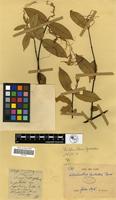
Name
Identification
Strophanthus bracteatus Franch. [family EUPHORBIACEAE ] Verified by Not on sheet, Strophanthus preussii Engl. & Pax [family APOCYNACEAE ] (stored under name); Verified by S. Diop, 2008
Related name
- Strophanthus preussii
- Strophanthus bracteatus
Flora
Entry for STROPHANTHUS Preussii Engl. & Pax [family APOCYNACEAE]
Herbarium
Royal Botanic Gardens, Kew (K)
Collection
Flora of Tropical Africa
Resource Type
Reference Sources
Entry From
Flora of Tropical Africa, Vol 4, Part 1, page 24, (1904) Author: (By Otto Stapf.)
Names
STROPHANTHUS Preussii Engl. & Pax [family APOCYNACEAE], in Engl. Jahrb. xv. 369. —Franch. in Nouv. Arch. Mus. Paris, 3 sér. xv. 279; K. Schum. in Engl. & Prantl, Pflanzenfam. iv. ii. 182, and in Engl. Jahrb. xxiii. 230; and in Schlechter, Westafr. Kautschuk-Exped. 307; Hiern in Cat. Afr. Pl. Welw. i. 670; De Wild. & Durand, Contrib. Fl. Congo, i. 41; Gilg in Engl. Jahrb. xxxii. 155, 159. De Wild. & Dur. Pl. Thonner. Congol. 32.
Strophanthus bracteatus Franch. [family APOCYNACEAE], in Journ. de Bot. vii. 324 (see below).
STROPHANTHUS bracteatus De Wild. & Durand [family APOCYNACEAE], Contrib. Fl. Congo, ii. 41 and Reliq. Dewevr. ii. 154, not of Franch.
Information
A rambling or climbing shrub, up to 12 ft. high; branches glabrous, brown or reddish-brown, dotted with white lenticels. Leaves elliptic or oblong to obovate or ovate, abruptly acuminate, rounded or acute at the base, 2–5 in. long, 1 1/2–2 in. broad, membranous, quite glabrous; secondary nerves 6–7 on each side; veins quite inconspicuous. Cymes terminal, peduncled, usually many-flowered, corymbose, minutely puberulous; peduncle from very short to 1 1/2 in.; bracts foliaceous, thin, pallid, ovate to lanceolate, narrowed towards the base, obtuse or acute, 4–8 lin. long; pedicels up to 4 lin. long. Calyx foliaceous, 7–10 lin. long; outer sepals from a broad ovate base, linear-oblong or linear, inner linear-oblong or linear, glabrous. Corolla minutely pulverulent without and within, cream-coloured to orange, with purple spots and streaks in the throat and purple tails; infrastaminal part 5 lin. long, suprastaminal part campanulate, 4–5 lin. long; lobes ovate, suddenly con stricted and produced into filiform tails up to 1 ft. long; throat-scales ovate, broad, obtuse, papillose. Anthers included, 1 1/2 lin. long, with a short very fine point, tomentose on the back. Ovary hairy.
Distribution
Angola Lower Guinea Pungo Andongo; bushy places at Santo Antonio, Welwitsch, 5995! Golungo Alto; in woods between the River Delamboa and the Capopa spring, Welwitsch, 5996!Gaboon Lower Guinea Klaine, 1996.Congo South Central in thickets on a humid plain by the River Congo at Bombati, near Ndobo, 1300 ft., Thonner. Bokakata on the River Lulonga, Dewèvre, 809!Gold Coast Upper Guinea Aburi, Johnson, 150!Lagos Upper Guinea Ojuwaye, Millen, 27! Otta, Barter, 3322! Abeokuta, Harrison, 6! interior, Rowland! Ishagamo, Schlechter.Togo Upper Guinea Baumann, 591A!Nigeria Upper Guinea Old Calabar, Thomson, 9! Monteiro! Holland, 22! 100! Cross River, at Ikorofion, Holland, 33!Cameroons Upper Guinea Johann Albrechtshöhe, Staudt, 664! Yaunde, Zenker & Staudt, 301! 667! Zenker, 244! and without precise locality, Preuss, 116! near Victoria, Preuss, 1114, 1328; Barombi Gorge, Preuss, 116.Fernando Po Upper Guinea Mann, 177!
Notes
A pair of follicles collected by G. Mann in Fernando Po in 1860 (about the same time as the flowering specimen No. 177, quoted above) belongs very probably to S. Preussii. The follicles are hornshaped with rather obtuse ends, 10 in. long, 1 1/2 in. in. diam., reddish-brown and smooth. The seeds are oblong-lanceolate, obtuse at the base, long acuminate, brown, downy, 5–6 lin. long; the naked foot of the awn measures 1 2/3–2 in., the plume 3/4– 1/4 in. The follicles collected by Mann in Fernando Po in 1860 referred to by me in a to S. Preussii do not belong to this species, as Gilg who had an opportunity of examining seeds of this species has pointed out. A description of the follicles and seeds will be found under S. bracteatus, Franch., which Gilg, after an examination of an authentic specimen, declares to be identical with S. Preussii .