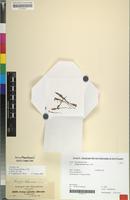
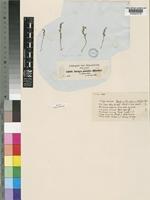
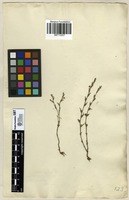
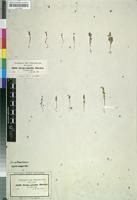
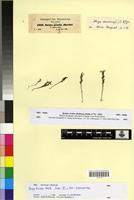
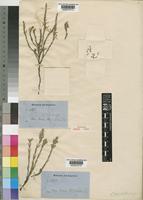
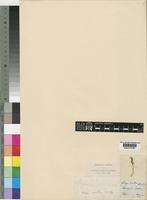
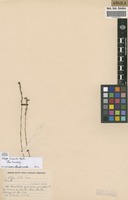
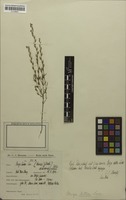
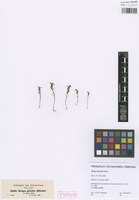
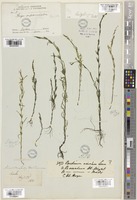
an erect herb, scabrid, hispidulous, grey-green, branched or rarely simple, annual, 2–18 in. high; branches ascending, slender, frequently fastigiate, rigid, leafy, angular; leaves opposite or the upper alternate, linear, acute or obtuse, somewhat narrowed at the sessile narrowly decurrent base, 1/2–2 1/4 in. long, 1/40– 1/8 in. broad, entire, spreading or suberect; flowers carmine or bright scarlet in our specimens, rather numerous, about 1/2 in. long, sessile or subsessile; spikes rather dense, slender, leafy, elongating; bracts linear-subulate, usually exceeding the calyx, adpressed below to the calyx; bracteoles subulate, shorter than the calyx-tube, adpressed, rigid, scabrid; calyx narrow, about 1/4 in. long; tube turbinate at the base in flower, rounded at the base in fruit, 10-ribbed, scabrid, about 1/6 in. long; lobes 5, lanceolate, subulate, somewhat unequal, 1/16– 1/12 in. long; corolla-tube subcylindrical, about 1/4– 1/2 in. long, slender, minutely glandular-puberulous outside, finely pilose within, rather strongly bent above the middle; limb spreading; lobes obovate, 1/8– 1/6 in. long; upper lip much shorter than the lower; stamens glabrous, inserted above the middle of the corolla-tube; capsules minutely glandular-papillose, oval-oblong, included in the calyx, about 1/6 in. long, 1/12 in. broad. null