JSTOR Global Plants Home
  • Home
  • Browse
  • About
  • Access
  • Account
    • Saved Items
    • Profile
  • Log in

Global Plants

Skip to Main Content
  • JSTOR Global Plants Home
  • Global Plants

    • Browse
    • About
    • Access
    • Account
      • Saved Items
      • Profile
Log in
  • Browse
  • About
  • Access
  • Account
    • Saved Items
    • Profile
Advanced Search

Compilation
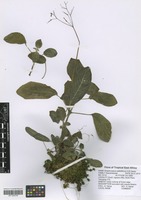
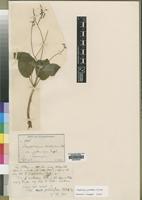
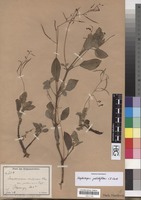
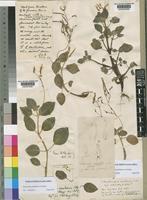
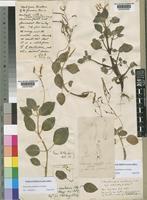
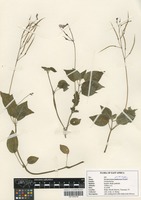
Streptocarpus pallidiflorus

6 Images see all

Filed as Streptocarpus pallidiflorus C. B. Clarke [family GESNERIACEAE]
Syntype of Streptocarpus pallidiflorus C.B.Clarke [family GESNERIACEAE]
Filed as Streptocarpus pallidiflorus C.B. Clarke [family GESNERIACEAE]
Syntype of Streptocarpus pallidiflorus C.B.Clarke [family GESNERIACEAE]
Streptocarpus pallidiflorus C.B.Clarke [family GESNERIACEAE]
Filed as Streptocarpus pallidiflorus C. B. Clarke [family GESNERIACEAE]
Previous
Next

Name

Identification
Streptocarpus caulescens Engl. [family GESNERIACEAE ] Streptocarpus pallidiflorus C.B.Clarke [family GESNERIACEAE ] (stored under name); Verified by Darbyshire,I.,
Related name
  • Streptocarpus pallidiflorus
  • Streptocarpus caulescens

Flora

Entry for Streptocarpus pallidiflorus C.B.Clarke [family GESNERIACEAE]
Herbarium
Royal Botanic Gardens, Kew (K)
Collection
Flora of Tropical East Africa
Resource Type
Reference Sources
Entry From
Flora of Tropical East Africa, page 1, (2006) Author: IAIN DARBYSHIRE
Names
Streptocarpus pallidiflorus C.B.Clarke [family GESNERIACEAE], in F.T.A. 4(2): 508 (1906); Hilliard & B.L. Burtt in Notes Roy. Bot. Gard. Edinb. 43: 231 (1986). Type: Tanzania, Kilimanjaro, Marangu, Volkens 1006 (B†, holo.; K, lecto., selected by Hilliard & B.L. Burtt (1986), missing; BM!, isolecto.)
Streptocarpus caulescens Engl. var. pallescens [family GESNERIACEAE], in E.J. 19: 154 (1894), Hilliard & B.L. Burtt, Streptocarpus: 333, t. 15 (1971). Type as for S. pallidiflorus C.B.Clarke
Streptocarpus caulescens (Engl.) Engl. fa. pallescens [family GESNERIACEAE], P.O.A.: 363 (1895)
Streptocarpus caulescens [family GESNERIACEAE], [ sensu Hook.f. in Bot. Mag. 111: t. 6814 (1885) & sensu B.L. Burtt in K.B.: 82 (1939) pro parte, non Vatke]
Information
Upright or sometimes straggling caulescent herb, 10–30(–60) cm tall. Stems succulent, reddish, often strongly swollen at the base where up to 2 cm diameter, often branching above the base, spreading-pubescent particularly when young. Leaves opposite, pairs subequal; blade somewhat fleshy, ovate-elliptic, 1.5–6.5 cm long, 0.8–4 cm wide, base asymmetrically rounded or subcordate to shortly attenuate, margin entire, apex acute to subacuminate, surfaces densely pubescent particularly on the nerves beneath, rarely more sparsely so; lateral nerves 7–11 pairs; petiole 1–2(–3.5) cm long, densely pilose. Inflorescence axillary, solitary, 3–10-flowered; peduncle 3–10(–15) cm long, pubescent towards the base, largely glabrous towards the apex; pedicels fine, 10–20 mm long, glabrous or with scattered eglandular and/or glandular hairs, rarely pubescent; bracts linear, 1–2 mm long, pubescent, often early caducous. Calyx lobes purplish, ovate-lanceolate, 2–3 mm long, sparsely pubescent, occasionally with glandular hairs, with or without scattered subsessile glands. Corolla pale mauve or whitish, rarely purple, usually striped with dark pink to purple lines, 12–20 mm long; tube 6–9 mm long, strongly ventricose on the floor above the middle where 3–4 mm deep, glandular-pilose outside, papillose within below the origin of the stamens and at the mouth; limb bilabiate, oblique; upper lip of two erect, rounded lobes 2–3 mm long and wide, lower lip 6–11 mm long, protruding, the three lobes spreading, usually oblong-rounded, 3–6 mm long, 3–4.5(–6) mm wide, palate curved upwards, weakly ridged so that the mouth is open but vertically compressed. Stamens arising from the upper half of the corolla tube; filaments 2–3 mm long, straight, glabrous; anther thecae divergent, ± 0.8 mm wide; staminodes minute. Ovary cylindric, 4.5–6 mm long, glabrous except for scattered subsessile glands, rarely sparsely pubescent; style 1.5–3 mm long, glabrous; stigma capitate, ± 0.4 mm wide, papillose. Capsule 20–45 mm long, 1.5–2 mm diameter, glabrous. Seeds 0.4–0.6 mm long, verruculose with slight longitudinal ridging. Fig. 2, p. 17.
Range
DISTR. K 7; T 2, 3, 6, 7 not known elsewhere
Altitude range
750–2100(–2750) m
Distribution
KENYA Kwale District Kilibasi Hill, Nov. 1989, Luke & Robertson 2052! & fl. in hort. Luke, Aug. 1997, Luke 4705!TANZANIA Arusha District Loitang, Ngurdoto Crater, Oct. 1965, Greenway & Kanuri 12109!TANZANIA Lushoto District W Usambara Mts, Lushoto-Mkuzi road near Magamba fork, Apr. 1953, Drummond & Hemsley 2131!TANZANIA Morogoro District Uluguru North Forest Reserve, ridge above Maunga Valley W of Bondwa, July 1972, Mabberley 1211!
Notes
USES. Cultivated as an ornamental CONSERVATION This species is recorded as locally common at several collecting localities within its range and is adaptable to a range of habitats including forest edges and open rock outcrops, thus is unlikely to be threatened by agricultural encroachment. It is therefore assessed as of Least Concern (LC). Flower colour in this species is somewhat variable. Most widespread are those with a pale mauve corolla striped with purple lines on the limb (particularly the upper lip). However, in the W Usambaras and at Kilibasi in Kenya, where the flowers are at the higher end of the size range, they are deeper purple and often lack the striping, at least on the lobes of the lower lip; these thus resemble in colour the flowers of S. caulescens Vatke, from which they are distinguished by the conspicuously ventricose tube. The two collections from Kilibasi in Kenya, both derived from the same population, are interesting in that the pedicels are rather densely pubescent, the peduncles and calyces also being more pubescent than typical for this species, although this is most notable in the cultivated specimen (Luke 4705!). If further collections from this area prove this to be a consistent character, it may warrant subspecific status. One of the original syntypes of this taxon, Hannington s.n.!, is unusual in that the ovaries are sparsely hairy which C.B. Clarke used to aid separation of this species from S. caulescens Vatke. However, this character is not repeated in subsequent collections, all having glabrous ovaries excepting the scattered subsessile glands. In all other respects, Hannington s.n. closely resembles specimens included under S. pallidiflorus ,and as variable indumentum is well known in this genus, it is clear that they represent the same taxon.

Related Materials

  • Terms and Conditions
  • Privacy Policy
  • Cookie Policy
  • Cookie Settings
  • Accessibility
  • Help
  • Contact Us
  • Facebook
  • Twitter
ITHAKA

JSTOR is part of ITHAKA, a not-for-profit organization helping the academic community use digital technologies to preserve the scholarly record and to advance research and teaching in sustainable ways.

©2000-2026 ITHAKA. All Rights Reserved. JSTOR®, the JSTOR logo, JPASS®, Aluka®, and ITHAKA® are registered trademarks of ITHAKA.

╳