

Compilation
Streptocarpus ovatus
1 Images see all
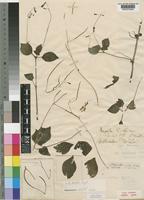
Name
Identification
Streptocarpus ovatus (C.B.Clarke) C.B.Clarke [family GESNERIACEAE ] Verified by Clarke, C.B., Streptocarpus caulescens Vatke [family GESNERIACEAE ] Streptocarpus holstii Engl. [family GESNERIACEAE ] (stored under name); Verified by Burtt, B.L., Streptocarpus holstii Engl. [family GESNERIACEAE ] Verified by A.A.B.,
Related name
- Streptocarpus caulescens
- Streptocarpus ovatus
- Streptocarpus holstii
Flora
Entry for Streptocarpus holstii Engl. [family GESNERIACEAE]
Herbarium
Royal Botanic Gardens, Kew (K)
Collection
Flora of Tropical East Africa
Resource Type
Reference Sources
Entry From
Flora of Tropical East Africa, page 1, (2006) Author: IAIN DARBYSHIRE
Names
Streptocarpus holstii Engl. [family GESNERIACEAE], in E.J. 18: 77 (1893); Baker & C.B. Clarke in F.T.A. 4(2): 508 (1906); Hemsley in Bot. Mag. 83: t. 8150 (1907); B.L. Burtt in K.B.: 83 (1939); Hilliard & B.L. Burtt, Streptocarpus: 334, fig. 49 (1971); Iversen in Symb. Bot. Upsal. 28: 243 (1988). Type: Tanzania, Lushoto District, Usambara, Nderema, Holst 2233 (B†, holo.; K!, iso.)
Streptocarpus caulescens C.B.Clarke var. ovatus [family GESNERIACEAE], in Monogr. Phan. 5: 154 (1883). Type: Tanzania, Lushoto District, Usambara, Magila, Kirk (K!, holo.)
Streptocarpus ovatus (C.B.Clarke) C.B.Clarke [family GESNERIACEAE], in F.T.A. 4(2): 508 (1906)
Information
Caulescent herb, 20–60 cm tall, much-branched, branches usually decumbent. Stems somewhat succulent, subangular, nodes sometimes slightly constricted in dry material, sparsely spreading-pubescent, more densely pubescent at the nodes. Leaves opposite, pairs subequal to unequal; blade broadly ovate to ovate-elliptic, base rounded or obtuse, ± asymmetric, margin entire, apex bluntly acute or subacuminate, ciliate, upper surface sparsely pilose with clearly multicellular hairs, occasionally glabrous, lower surface pilose on the nerves, sparsely pubescent elsewhere; lateral nerves 6–10 pairs; petiole 0.5–3.5 cm long, pubescent with mixed long and short hairs. Inflorescences axillary to the upper leaves, solitary, 2–6-flowered; peduncles 2.5–8(–10) cm long, glabrous except for scattered hairs towards the base; pedicels 8–25 mm long, glabrous or sparsely glandular-pilose, bent at the apex rendering the flowers pendulous; bracts linear, ± 1.5 mm long, pubescent, often early caducous. Calyx lobes purplish, oblong-lanceolate with a blunt green tip, 2–3 mm long, with or without scattered glandular and eglandular hairs. Corolla (18–)20–29 mm long, sparsely glandular-pubescent outside; tube blue-purple, cylindric, 9–12 mm long, slightly swollen at the base, slightly curved and laterally compressed, 3(–3.5) mm deep, papillose on the floor within; limb bilabiate, highly oblique; upper lip of two erect lobes, blue to blue-purple at the margins, white towards the base, rounded, 2–4 mm long, 3–5 mm wide; lower lip protruding, blue to blue-purple except for a white palate with deeper blue flecks towards the edges, 10–15(–20) mm long, lateral lobes rounded or obtuse, 4–6 mm long, 6–9 mm wide, median lobe rounded or with a somewhat truncate apex, narrowed at base, 4.5–6 mm long, 6–9 mm wide, palate strongly upcurved and two-ridged, the mouth closed except for the narrow groove between the palate ridges. Stamens arising from the upper third of the corolla tube, lying flat on tube floor; filaments white, converging, 3–3.5(–5) mm long, glabrous; anthers white, thecae somewhat divergent, 0.5–0.6 mm wide; staminodes minute. Ovary cylindric, 4.5–5.5 mm long, glabrous except for scattered subsessile glands; style white, 3–5 mm long, glabrous; stigma shallowly depressed centrally, ± 0.6 mm wide, papillose. Capsule 30–55 mm long, 1–2 mm diameter, glabrous. Seeds 0.45–0.6 mm long, verruculose.
Range
DISTR. T 3 restricted to the E Usambara Mts
Altitude range
750–1250 m
Distribution
TANZANIA Lushoto District E Usambara Mts, Amani, Sept. 1933, B.D. Burtt 4862! & Kwamkoro-Ngua, Dec. 1936, Greenway 4815! & Mt Bomole, May 1950, Verdcourt 183!
Notes
USES. Cultivated as an ornamental. CONSERVATION The highly localised distribution of this species and its requirement for primary forest renders it vulnerable to the widespread human encroachment in the east Usambaras. Only twelve wild collections have been seen despite extensive collection in these mountains, thus it appears scarce. It is therefore assessed as Vulnerable (VU B1ab(iii)+2ab(iii))