JSTOR Global Plants Home
  • Home
  • Browse
  • About
  • Access
  • Account
    • Saved Items
    • Profile
  • Log in

Global Plants

Skip to Main Content
  • JSTOR Global Plants Home
  • Global Plants

    • Browse
    • About
    • Access
    • Account
      • Saved Items
      • Profile
Log in
  • Browse
  • About
  • Access
  • Account
    • Saved Items
    • Profile
Advanced Search

Compilation
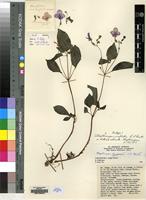
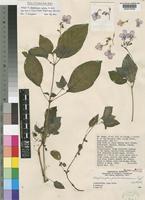
Streptocarpus inflatus

2 Images see all

Isotype of Streptocarpus inflatus B.L.Burtt [family GESNERIACEAE]
Previous
Next

Name

Identification
Isotype of Streptocarpus inflatus B.L.Burtt [family GESNERIACEAE ] (stored under name); Verified by Not on sheet, Streptocarpus buchananii C.B.Clarke [family GESNERIACEAE ] Verified by R. Polhill&A. Paulo No., 1962
Related name
  • Streptocarpus glandulosissimus
  • Streptocarpus inflatus
  • Streptocarpus buchananii

Flora

Entry for Streptocarpus inflatus B.L.Burtt [family GESNERIACEAE]
Herbarium
Royal Botanic Gardens, Kew (K)
Collection
Flora of Tropical East Africa
Resource Type
Reference Sources
Entry From
Flora of Tropical East Africa, page 1, (2006) Author: IAIN DARBYSHIRE
Names
Streptocarpus inflatus B.L.Burtt [family GESNERIACEAE], in Hilliard & B.L. Burtt, Streptocarpus: 389 (1971). Type: Tanzania, Iringa District, Mt Image, Polhill & Paulo 1619 (E, holo.; EA!, K!, iso.)
Information
Caulescent herb to 30 cm tall. Lower stem creeping and rooting at the nodes, sometimes swollen, somewhat succulent, flowering stems decumbent, with scattered spreading hairs and subsessile glands. Leaves opposite, somewhat unequal to subequal; blade (ovate-)elliptic, 3–10 cm long, 1.5–5 cm wide, base asymmetrically obtuse to subcordate, margin entire, apex bluntly acute to subacuminate, surfaces sparsely pubescent mainly on the nerves beneath, ciliate; lateral nerves 6(–8) pairs, sometimes purple beneath; petiole 1–4 cm long, sparsely pubescent or glabrescent. Inflorescences axillary to the upper leaves, solitary, 2–10-flowered; peduncles 3–7 cm long, largely glabrous towards the base, becoming sparsely glandular- and eglandular-pubescent and with subsessile glands towards the apex; pedicels 3–6 mm long, with dense subsessile glands and less dense long glandular-hairs; bracts linear, 1–2 mm long, early caducous. Calyx lobes linear-lanceolate, bluntly tipped, 3.5–5.5 mm long, sparsely pubescent with mainly eglandular hairs, with scattered subsessile glands outside and within. Corolla 25–32 mm long; tube mauve, curved-cylindric, 14–17 mm long, laterally constricted, inflated on the roof above the base where 3 mm deep, narrowing to 1.5–2 mm, sparsely glandular-pubescent towards the mouth; limb bilabiate, oblique, lips blue darkening to purple towards centre, throat white; upper lip of two erect, rounded lobes, 5–6.5 mm long, 4–5 mm wide; lower lip protruding, 12–15.5 mm long, lateral lobes rounded or somewhat obtuse, 6–9 mm long, 8.5–10 mm wide, median lobe rounded, 7–10.5 mm long, 9.5–12 mm wide, palate curved upwards, mouth narrow vertically. Stamens arising from the upper third of the corolla tube; filaments 2–3 mm long, glabrous; anther thecae divergent, 0.8 mm wide; staminodes minute. Ovary cylindric, 4–7 mm long, glabrous except for scattered fine hairs and subsessile glands; style white, 4–6 mm long, glabrous; stigma white, capitate, 0.6–0.8 mm wide, papillose. Capsule 35–55 mm long, 1.5–2 mm diameter, glabrous. Seeds 0.6–0.8 mm long, minutely verruculose, slightly longitudinally ridged.
Range
DISTR. T 7 restricted to Mt Image and the Udzungwa Mts
Altitude range
2100–2350 m
Distribution
TANZANIA Iringa District Mt Image, Apr. 1986, Congdon 68! & Luhombero Massif, Aug. 1985, Rodgers & Hall 4375! & Udzungwa Mt National Park, May 2002, Luke et al. 8478!
Notes
USES. None recorded on herbarium specimens. CONSERVATION This species is clearly rare, being known from only six collections, three of which are from Mt Image. It has only recently been discovered at its second and third sites, both within the Udzungwa Mt National Park. No data on present abundance are available for its known locations or on the threats to these populations, although as it is found at such high altitudes, human impact upon its habitat may still be minimal. However, due to its highly restricted range, it is threatened by losses of subpopulations through natural stochastic events, such as forest fires, and is thus provisionally assessed as Vulnerable (VU D2)

Related Materials

  • Terms and Conditions
  • Privacy Policy
  • Cookie Policy
  • Cookie Settings
  • Accessibility
  • Help
  • Contact Us
  • Facebook
  • Twitter
ITHAKA

JSTOR is part of ITHAKA, a not-for-profit organization helping the academic community use digital technologies to preserve the scholarly record and to advance research and teaching in sustainable ways.

©2000-2026 ITHAKA. All Rights Reserved. JSTOR®, the JSTOR logo, JPASS®, Aluka®, and ITHAKA® are registered trademarks of ITHAKA.

╳