

Compilation
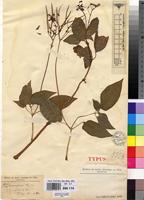
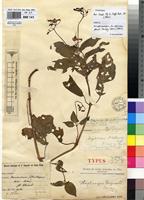
Streptocarpus bequaertii
2 Images see all
Name
Identification
Streptocarpus bequaertii De Wild. [family GESNERIACEAE ] Verified by Not on sheet, Streptocarpus glandulosissimus Engl. [family GESNERIACEAE ] (stored under name); Verified by Lawalree A. & Robyns W., 1943
Related name
- Streptocarpus glandulosissimus
- Streptocarpus bequaertii
Flora
Entry for Streptocarpus glandulosissimus Engl. [family GESNERIACEAE]
Herbarium
Royal Botanic Gardens, Kew (K)
Collection
Flora of Tropical East Africa
Resource Type
Reference Sources
Entry From
Flora of Tropical East Africa, page 1, (2006) Author: IAIN DARBYSHIRE
Names
Streptocarpus glandulosissimus Engl. [family GESNERIACEAE], in E.J. 18: 78 (1893); Baker & C.B. Clarke in F.T.A. 4(2): 509 (1906); B.L. Burtt in K.B.: 82 (1939); Hilliard & B.L. Burtt, Streptocarpus: 337 (1971); Troupin in Fl. Rwanda, Spermatophytes 3: 499, fig. 151 (1985); Blundell, Wild Fl. E. Afr.: 380, t. 598 (1987); Agnew, U.K.W.F. ed. 2: 264 (1994). Types: Tanzania, Lushoto District, Usambara Mts, Mlalo, Holst 99 (B†, syn.) & Usambara Mts, Mtai, Tewe-Bach, Holst 2472 (B†, K!, HBG, syn.)
Streptocarpus volkensii Engl. [family GESNERIACEAE], in E.J. 19: 153 (1894); Baker & C.B. Clarke in F.T.A. 4(2): 510 (1906). Type: Tanzania, Kilimanjaro, Marangu, Volkens 589 (B†, holo.; BM!, BR, K!, iso.)
Streptocarpus ruwenzoriensis Baker [family GESNERIACEAE], in F.T.A. 4(2): 510 (1906). Types: Uganda, Ruwenzori, Scott-Elliott 7936 (BM!, K!, syn.) & 7968 (BM!, syn.); Kenya, Taylor s.n. (BM!, syn.) & Doggett s.n. (K!, syn.)
Streptocarpus smithii C.B.Clarke [family GESNERIACEAE], in F.T.A. 4(2): 511 (1906). Type: Tanzania, Lushoto District, Usambara Mts, Umba Valley, Smith (K!, holo.)
Streptocarpus bequaertii De Wild. [family GESNERIACEAE], in Rev. Zool. Afr. 8, Suppl. Bot.: 38 (1920). Type: Congo-Kinshasa, Ruwenzori, Butahu [Batagu] valley, Bequaert 3554 (BR, holo.)
Streptocarpus mildbraedii Engl. [family GESNERIACEAE], in E.J. 57: 215 (1921). Type: Congo-Kinshasa, W Ruwenzori, Butahu [Butago] valley, Mildbraed 2497 (B†, holo.)
Streptocarpus tchenzemae Gilli [family GESNERIACEAE], in Ann. Naturhist. Mus. Wien 77: 54 (1973). Type: Tanzania, Morogoro District, Uluguru Mts, Chenzema, Gilli 549 (W!, holo.), syn. nov.
Information
Perennial caulescent herb, straggling or subscandent, to 150(–200) cm tall. Stems somewhat succulent, weak, sometimes constricted at the nodes in dried material, branching, pubescent when young, glabrescent except for the pilose nodes, stomata often visible as purple streaks. Leaves opposite, pairs somewhat unequal or subequal; blade variable, ovate to ovate-elliptic, 3.5–14 mm long, 2–6 cm wide, base shallowly cordate to rounded or obtuse, often highly asymmetric, becoming cordate on one side and obtuse on the other, margin entire, apex acuminate or more rarely acute, surfaces pilose; lateral nerves 8–15 pairs; petiole 1–4.5(–6) cm long, pilose. Inflorescences axillary to the upper leaves, solitary, 4–22-flowered; peduncles 5–16 cm long, eglandular-pilose at the base, with progressively more glandular hairs towards the apex; pedicels 6–20 mm long, glandular-pilose, often densely so, the hair-walls pigmented purple, with shorter eglandular hairs and subsessile glands; bracts linear-lanceolate, 2.5–5 mm long, pilose, often early caducous. Calyx lobes broadly lanceolate, 2.5–4.5 mm long, blunt-tipped, pilose with mainly eglandular hairs except towards the base where hairs mainly glandular, with scattered subsessile glands. Corolla blue-purple to purple, often with a paler or whitish mouth, 16–30 mm long, glandular-pilose outside particularly on the tube; tube cylindric, 7–13 mm long, 2.5–3(–4) mm deep, slightly swollen above the base, sometimes slightly ventricose on the floor of the upper half, papillose on the floor within; limb bilabiate, oblique; upper lip of two erect, rounded lobes, 3–5 mm long, 4–6 mm wide, united to midway; lower lip protruding, 12–20 mm long, lateral lobes rounded to asymmetric, 5–8(–10) mm long, 5.5–13.5(–15.5) mm wide, median lobe rounded or with a truncate to shallowly emarginate apex, 5–10.5 mm long, 7–17 mm wide, palate upcurved and two-ridged with a central groove, the mouth strongly vertically compressed, papillose. Stamens arising from the upper third of the corolla tube; filaments converging, 3–4 mm long, glabrous or with scattered short hairs; anther thecae divaricate, 0.8 mm wide; staminodes minute. Ovary cylindric, 4–6 mm long, densely appressed-pubescent with scattered subsessile glands; style 3–4 mm long, becoming glabrous towards the apex; stigma capitate, 0.6–1 mm wide, papillose. Capsule 35–60 mm long, 1.5–2 mm diameter, sparsely pubescent. Seeds 0.4–0.6 mm long, minutely verruculose with weak longitudinal ridges. Fig. 3, p. 21.
Range
DISTR. U 2; K 1, 4; T 2, 3, 6, 7 mountains of the central African lakes region in Congo-Kinshasa, Rwanda and Burundi
Altitude range
(900–)1200–2250(–2600) m
Distribution
KENYA Northern Frontier District Mt Kulal, Dec. 1958, T. Adamson K.20!KENYA South Nyeri District Castle Forest Station, Dec. 1966, Kabuye 41!KENYA Kiambu District Gatamayu Forest, Dec. 1959, Napper 1483!TANZANIA Moshi District Kilimanjaro, S slope between the Umbwe and Weru Weru R., Aug. 1932, Greenway 3024!TANZANIA Lushoto District Usambara Mts, forest above Lushoto, July 1960, Leach & Brunton 10192!TANZANIA Morogoro District Uluguru Mts, Nyandiduma Forest Reserve, Mar. 1955, Semsei 2007!UGANDA Ruwenzori, Mahoma, June 1953, Osmaston 3850! & Bwamba Pass, Nov. 1935, A.S. Thomas 1463! & Mubuku Valley, Dec. 1938, Loveridge 283!
Notes
USES. Cultivated as an ornamental. CONSERVATION This is the most widespread species of Streptocarpus within our region and is often locally common to abundant within suitable habitat in the highlands of east and central Africa, though is notably absent from the Kenyan highlands west of the Rift Valley and from Mt Elgon. As S. glandulosissimus appears adaptable to a range of habitats and can survive in forest margins as well as pristine forest, it is not likely to experience threatening population declines at present and is thus assessed as of Least Concern (LC). A somewhat variable species, particularly with regard to pedicel indumentum. In the Ruwenzori and in some of the Kenyan collections, the pedicels are only sparsely glandular-pilose, with eglandular hairs dominating. Such specimens were previously considered a separate species, S. ruwenzoriensis Baker, but were correctly reduced to synonymy by Hilliard & B.L. Burtt (1971), as this and other diagnostic characters, notably the relative bluntness of the calyx lobes, are highly variable. The southernmost collections from Tanzania again display variable pedicel indumentum. Collections from the Udzungwa Mts (e.g. Polhill & Lovett 5155!, Norbury F27! & Bridson 604!) are particularly notable in displaying very sparse glandular hairs on the pedicels, but those from elsewhere in Iringa District are more typically densely glandular-pilose. The former specimens are somewhat difficult to separate from S. buchananii C.B.Clarke on inflorescence characters, but have small, ovate leaves with an acuminate apex, asymmetrically rounded base and rather dense indumentum which closely agree with other collections of S. glandulosissimus from Iringa. S. tchenzemae Gilli was separated from S. glandulosissimus on the basis of its taller stature with longer internodes and a longer corolla tube. Whilst the corolla tube length of 13 mm d on the type specimen is at the longest end of the range for this species, it otherwise closely matches other specimens of S. glandulosissimus in indumentum, leaf characteristics and corolla form and is thus considered synonymous with that species.