JSTOR Global Plants Home
  • Home
  • Browse
  • About
  • Access
  • Account
    • Saved Items
    • Profile
  • Log in

Global Plants

Skip to Main Content
  • JSTOR Global Plants Home
  • Global Plants

    • Browse
    • About
    • Access
    • Account
      • Saved Items
      • Profile
Log in
  • Browse
  • About
  • Access
  • Account
    • Saved Items
    • Profile
Advanced Search

Compilation
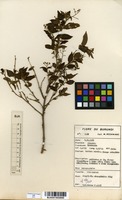
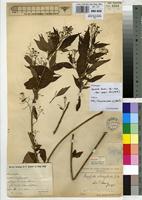
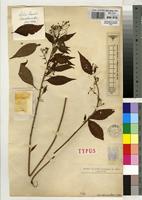
Stapfiella claoxyloides

3 Images see all

Filed as Stapfiella claoxyloides Gilg [family TURNERACEAE]
Neotype of Stapfiella claoxyloides Gilg [family TURNERACEAE]
Previous
Next

Name

Identification
Stapfiella claoxyloides Gilg [family TURNERACEAE ] (stored under name); Verified by Staner P., 1938
Related name
  • Stapfiella claoxyloides

Flora

Entry for STAPFIELLA claoxyloides Gilg [family TURNERACEAE]
Herbarium
Royal Botanic Gardens, Kew (K)
Collection
Flora of Tropical East Africa
Resource Type
Reference Sources
Entry From
Flora of Tropical East Africa, page 1, (1954) Author: J. Lewis
Names
STAPFIELLA claoxyloides Gilg [family TURNERACEAE], in Mildbr., Z.A.E. 571 (1913); Staner in Ann. Soc. Sci. Brux., sér. 2, 58: 106 (1938); J. Lewis in K.B. 1953: 282 (1953). Type: Ruanda Urundi, Rugege forest, Rukarara, Mildbraed 920 (B, holo. †) and Belgian Congo, Kabango, Bequaert 6174 (BR., neo.!, K, photo!)
Information
Medium sized, frequently glandular, shrubs with ± narrowly elliptic leaves and ± numerous small (less than 1 cm. long) flowers in axillary and terminal panicles. Calyx connate for less than half its length, bearing within 5 large (? glandular) tubercles. Petals eligulate, inserted at the opening of the calyx-tube. Filaments terete, adnate to calyx-tube for ± 0.25 mm. Stigmas fringed. Ovule solitary and basal. Capsule ± ellipsoid, 4–5 mm. long, dehiscing septicidally from the apex downwards; beak less than 0.5 mm. long. Seed solitary, straight, narrowly obovoid, filling capsule, longitudinally striate-submuricate.A genus confined to tropical Africa.Branches rusty brown, ± shortly and thickly grey-pubescent. Leaves 4–8.5 x 1–2.5 cm.; margin serrate, serrations “gland”-tipped, rarely hooked; apex acute or subacuminate; ± uniformly pubescent on both surfaces, especially on the midrib above and on (all) the nerves below; no gland-dots by transmitted light; petioles up to 1.5 (–2) cm. long, uniformly pubescent. Some of the bracts within the panicle foliaceous, up to 5 cm. long; ultimate bracts very small (less than 2 mm. long); all axes ± uniformly pubescent. Calyx-tube ± 0.25 mm. long; tubercles free apically, not fringed, margin sometimes bearing a few long hairs; calyx-lobes ± 1.75 x 0.5 mm. sparsely pubescent, not gland-dotted. Petals (? greenish-) white, ± 2 mm. long in mature bud. Ovary ± 0.75 x 0.3 mm., densely ciliate. Fruiting pedicels straight or slightly curved; capsules irregularly pubescent, not black gland-dotted. Aril more than half length of seed.
Range
DISTR. U2 also in eastern Belgian Congo and Ruanda-Urundi
Altitude range
1200–1500 m.
Distribution
UGANDA Kigezi District north-west, Sept. 1947, Dale 496!

Related Materials

  • Terms and Conditions
  • Privacy Policy
  • Cookie Policy
  • Cookie Settings
  • Accessibility
  • Help
  • Contact Us
  • Facebook
  • Twitter
ITHAKA

JSTOR is part of ITHAKA, a not-for-profit organization helping the academic community use digital technologies to preserve the scholarly record and to advance research and teaching in sustainable ways.

©2000-2026 ITHAKA. All Rights Reserved. JSTOR®, the JSTOR logo, JPASS®, Aluka®, and ITHAKA® are registered trademarks of ITHAKA.

╳