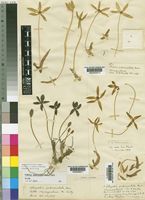
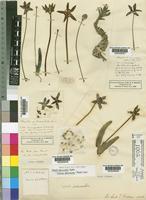
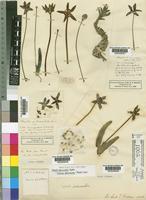
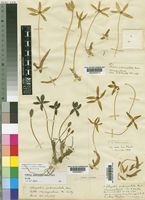
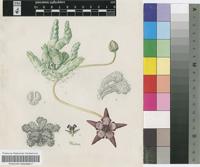
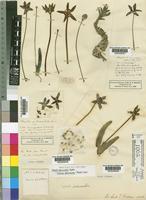
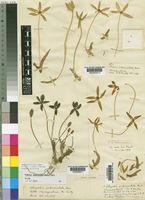
stems erect or decumbent at the base, 2–5 in. (up to 8 in., Barkly) long, 4–8 lin. thick, somewhat obscurely 4-angled and very slightly or indistinctly toothed, smooth, glabrous, greyish-green, mottled or tinted with faint purplish-brown where exposed to the sun, slightly glaucous when young; flowers 1–2 (and usually 2–5 buds which abort) together, near the base of the young stems, successively developed; pedicels erect, 3–6 in. long, much overtopping the stems, glabrous; sepals 2 1/2 lin. long, lanceolate-subulate, glabrous; corolla in bud ovoid, with 5 compressed angles; when expanded 1 1/2–2 1/4 in. in diam., very deeply lobed, smooth on the back, faintly punctate-rugulose on the inner face, light olive-brown with a slight golden tinge, or olive-green or light greenish-yellow, the basal part of the lobes and the small cup pale greyish-white, dotted with reddish-brown, beautifully ciliate with vibratile clavate dark purple hairs for about 1/4 in. along the margin near the base of the lobes, otherwise glabrous; tube scarcely any, the united part very shortly and broadly funnel-shaped or flattish; lobes horizontally spreading, with the margins rolled back so as to touch or overlap, forming a pointed cylinder, 7/8–1 1/4 in. long, 6–7 lin. broad when flattened out, lanceolate or elliptic-lanceolate, acute; outer corona-lobes spreading, comparatively very small, 1–1 1/4 lin. long, linear, usually truncate or emarginate or minutely 3-toothed at the apex, more rarely acute, channelled down the face, purple-black; inner corona-lobes 2-horned, purple-black, shining; horns very similar, each terminating in a large knob covered with sharp angular projections, the inner erect or subconnivent at the base, then recurved-spreading, about 2 lin. long, the outer rather shorter than and recurved-spreading under the inner horns; odour very nauseous, resembling stale dried salt-fish, but only present when the corolla is fully expanded. null