JSTOR Global Plants Home
  • Home
  • Browse
  • About
  • Access
  • Account
    • Saved Items
    • Profile
  • Log in

Global Plants

Skip to Main Content
  • JSTOR Global Plants Home
  • Global Plants

    • Browse
    • About
    • Access
    • Account
      • Saved Items
      • Profile
Log in
  • Browse
  • About
  • Access
  • Account
    • Saved Items
    • Profile
Advanced Search

Compilation
Stapelia nobilis

4 Images see all

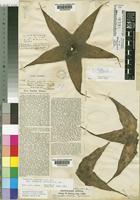
Stapelia gigantea N.E.Br. [family ASCLEPIADACEAE]
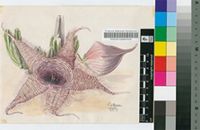
Stapelia nobilis N.E.Br.
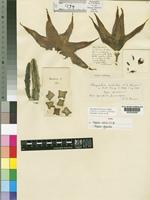
Type of Stapelia nobilis N.E.Br. [family ASCLEPIADACEAE]
Stapelia nobilis N.E.Br.
Previous
Next

Name

Identification
Stapelia nobilis N.E.Br. [family APOCYNACEAE ]
Related name
  • Stapelia nobilis

Flora

Entry for STAPELIA nobilis N. E. Br. [family ASCLEPIADACEAE]
Herbarium
Royal Botanic Gardens, Kew (K)
Collection
Flora Capensis
Resource Type
Reference Sources
Entry From
Flora Capensis, Vol 4, page 518, (1909) Author: By N. E. BROWN.
Names
STAPELIA nobilis N. E. Br. [family ASCLEPIADACEAE], in Bot. Mag. t. 7771
Information
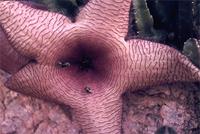
stems erect, decumbent and branching at the base, 3–5 in. long, 5–10 lin. square, with concave sides, softly pubescent, green; angles slightly compressed, with erect rudimentary leaves 1 lin. long at the teeth; flowers 1–5 together, near the base or middle of the young branches, successively developed; pedicels stout, 1 in. long, 2 1/4 lin. thick, velvety; sepals 3 1/2–4 lin. long, 1 1/2–1 3/4 lin. broad, ovate-lanceolate, acute, velvety; corolla very large, in bud ovoid, acuminate, with 5 projecting teeth below the middle, when expanded 5-lobed to 2/3 of the way down, the united part forming a distinct campanulate tube about 1 1/6 in. deep, 1 1/2 in. in diam.; lobes 2 3/4–4 in. long, 1 1/4–2 in. broad, ovate-lanceolate, acuminate, reflexed, puberulous and light reddish-purple on the back; inner face transversely rugulose, light ochreous yellow, everywhere marked with irregular transverse crimson lines and somewhat thinly covered with very fine long erect purple hairs, ciliate on the lobes with rather stouter simple purple hairs; outer corona-lobes ascending, 3 lin. long, 2/3 lin. broad, linear, 3-toothed at the apex, concave down the face, glabrous, purple-brown; inner corona-lobes dark purple-brown, with the dorsal wing free to the base, erect and parallel with the inner horn, 3 1/2–4 1/2 lin. long, 3/4–1 1/2 lin. broad, narrowly oblong or oblong-lanceolate, acute or obtuse, entire or denticulate at the upper part; inner horn 3–5 lin. long, subulate, triquetrous, erect, with slightly incurved tips, not contiguous at the middle part. null
Distribution
EASTERN REGION Natal; probably from the Drakensberg Range, Pillans, 28!KALAHARI REGION Transvaal; rocky hill-sides of the Magaliesberg Range, E. S. C. A. Herb. 868! and possibly a specimen from Nylstroom River, Nelson, 114 belongs here.SOUTH AFRICA without precise locality, Pillans, 6! and specimens cultivated at Kew! and Durban, Wood, 10773!
Notes
Closely allied to S. gigantea, N. E. Br., but the growth is more compact, the stems are not so stout and their angles very much less compressed than in that species; the flower is very similar in colour, but smaller, and its distinctly campanulate tube at once distinguishes it, whilst the hairs which clothe the whole inner surface are much more evident than they are in S. gigantea. Described from a living plant. There is some uncertainty about this species being really a native of Natal.

Related Materials

  • Terms and Conditions
  • Privacy Policy
  • Cookie Policy
  • Cookie Settings
  • Accessibility
  • Help
  • Contact Us
  • Facebook
  • Twitter
ITHAKA

JSTOR is part of ITHAKA, a not-for-profit organization helping the academic community use digital technologies to preserve the scholarly record and to advance research and teaching in sustainable ways.

©2000-2026 ITHAKA. All Rights Reserved. JSTOR®, the JSTOR logo, JPASS®, Aluka®, and ITHAKA® are registered trademarks of ITHAKA.

╳