JSTOR Global Plants Home
  • Home
  • Browse
  • About
  • Access
  • Account
    • Saved Items
    • Profile
  • Log in

Global Plants

Skip to Main Content
  • JSTOR Global Plants Home
  • Global Plants

    • Browse
    • About
    • Access
    • Account
      • Saved Items
      • Profile
Log in
  • Browse
  • About
  • Access
  • Account
    • Saved Items
    • Profile
Advanced Search

Compilation
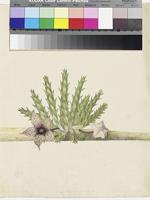
Stapelia irrorata

2 Images see all

Stapelia irrorata Masson original illustration by Francis Masson
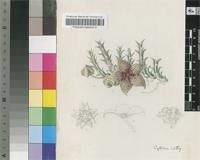
Stapelia irrorata Masson
Previous
Next

Name

Identification
Stapelia irrorata Masson [family APOCYNACEAE ]
Related name
  • Stapelia irrorata

Flora

Entry for STAPELIA irrorata Masson [family ASCLEPIADACEAE]
Herbarium
Royal Botanic Gardens, Kew (K)
Collection
Flora Capensis
Resource Type
Reference Sources
Entry From
Flora Capensis, Vol 4, page 518, (1909) Author: By N. E. BROWN.
Names
STAPELIA irrorata Masson [family ASCLEPIADACEAE], Stap. 12, t. 9;—Willd. Sp. Pl. i. 1291; Pers. Syn. Pl. i. 280; Poir. Encycl. vii. 388; Ait. Hort. Kew. ed. 2, ii. 94; Schultes, Syst. Veg. vi. 29; Spreng. Syst. Veg. i. 841; Dietr. Syn. Pl. ii. 887; Decne in DC. Prodr. viii. 655.
Podanthes irrorata Haw. [family ASCLEPIADACEAE], Syn. Pl. Succ. 33; G. Don, Gen. Syst. iv. 118.
Information
stems erect, decumbent at the base, 1 1/2–3 1/2 in. long, 1/3– 1/2 in. thick excluding the teeth, obtusely 4-angled, glabrous, green; teeth conical, acute, spreading, 2–3 lin. long; flowers solitary (always?) at the base of the stems; pedicels about 1 in. long, glabrous; sepals ovate, acute, glabrous; corolla about 2 3/4 in. in diam., pentagonal and acutely pointed in bud, glabrous and smooth outside, rugose on the glabrous inner face; disk depressed or saucer-shaped, purplish according to the figure; annulus none; lobes spreading, 3/4–1 in. long, 7–8 lin. broad, ovate, acuminate, not ciliate, pale yellow spotted and dotted with blood-red (purple-brown?);corona? null
Distribution
SOUTH AFRICA without locality, Masson.
Notes
This species only appears to differ from S. verrucosa by the corolla being destitute of an annulus. It has not been refound by any other collector, and no specimen of it appears to have been preserved.

Related Materials

  • Terms and Conditions
  • Privacy Policy
  • Cookie Policy
  • Cookie Settings
  • Accessibility
  • Help
  • Contact Us
  • Facebook
  • Twitter
ITHAKA

JSTOR is part of ITHAKA, a not-for-profit organization helping the academic community use digital technologies to preserve the scholarly record and to advance research and teaching in sustainable ways.

©2000-2026 ITHAKA. All Rights Reserved. JSTOR®, the JSTOR logo, JPASS®, Aluka®, and ITHAKA® are registered trademarks of ITHAKA.

╳