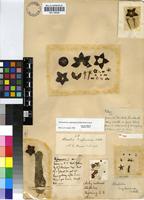
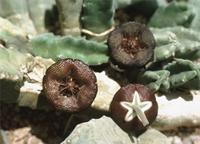
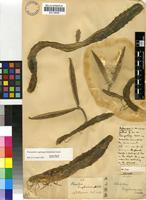
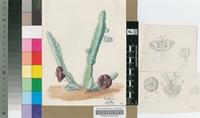
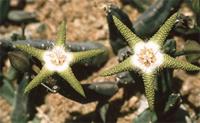
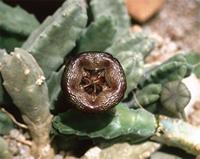
stems procumbent or decumbent with ascending tips, loosely or sparingly branched, 1/3–1 ft. long, 7–9 lin. square, with flattish or concave sides, shortly toothed at the angles, minutely velvety-pubescent, greyish-green, flowering near the middle or towards the apex on one of the sides; flowers solitary, sometimes with 1–4 other buds at the base of the pedicel, which appear to abort; pedicels 1/2– 3/4 (in fruit up to 1 1/3) in. long, velvety puberulous, as are also the 2–3 lin.-long lanceolate or ovate-lanceolate acute sepals; corolla (from the reflexion of its lobes) somewhat Turk's-cap-like, circular in outline and 10–12 lin. in diam., with a cup-like cavity or tube, softly puberulous on the back, rugose and glabrous on the inner face of the lobes and disk, puberulous with short erect hairs at the bottom of the tube, and with or without a minute ciliation on the lobes, dark purple-brown with or without faint yellowish transverse lines on the base of the lobes and rim of the tube, the bottom of the tube whitish, spotted with purple-brown; tube 3–4 lin. long and obtusely 5-angled outside and about 6 lin. in diam. at the acutely 5-angled mouth inside, broadly cup-like; lobes 5–8 lin. long, 5–6 lin. broad, deltoid-ovate, acute, closely reflexed upon the back of the tube; outer corona-lobes 1 1/2–2 lin. long, about 1 1/2 lin. broad, rhomboid with side angles or subquadrate, variably bifid, with or without a minute tooth in the notch or subtruncate and very minutely 3-toothed at the apex, purple-brown, mottled with ochreous or pale yellowish, or the central area and margins of that colour dotted with purple-brown; inner corona-lobes 2-horned, yellowish, dotted with purple-brown; outer horns erectly spreading, 2–2 1/2 lin. long, laterally compressed, linear, slightly clavate at the obtuse apex; inner horns connivent-erect at the base, then arching back nearly as far as the spread of the outer horns, 2 3/4–4 lin. long, filiform, more or less clavate and obtuse or acute at the apex; follicles 3 1/2–4 1/4 in. long, 4–5 lin. thick, terete-fusiform, tapering into a short slightly hooked beak, smooth, puberulous, streaked with dark green or dull purple-brown on a pale-coloured ground; seeds 2 1/2 lin. long, 3/4 lin. broad, narrowly lanceolate from the thickened margins being closely incurved on one face, smooth, light brown. null