

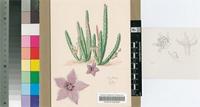
Name
Identification
Stapelia concinna Masson [family APOCYNACEAE ]
Related name
- Stapelia concinna
Flora
Entry for STAPELIA concinna Masson [family ASCLEPIADACEAE]
Herbarium
Royal Botanic Gardens, Kew (K)
Collection
Flora Capensis
Resource Type
Reference Sources
Entry From
Flora Capensis, Vol 4, page 518, (1909) Author: By N. E. BROWN.
Names
STAPELIA concinna Masson [family ASCLEPIADACEAE], Stap. 15, t. 18;—Willd. Sp. Pl. i. 1284, and Enum. Pl. Hort. Berol. Suppl. 14; Hayne, Term. Bot. ed. 1799, t. 16, fig. 8; Pers. Syn. Pl. i. 279; Poir. Encycl. vii. 382; Ait. Hort. Kew. ed. 2, ii. 89; Haw. Syn. Pl. Succ. 21; Schultes, Syst. Veg. vi. 20; Link, Enum. Pl. Hort. Berol. i. 254; Spreng. Syst. Veg. i. 839; G. Don, Gen. Syst. iv. 116; Dietr. Syn. Pl. ii. 885; Decne in DC. Prodr. viii. 654; Schlechter in Journ. Bot. 1898, 479.
Information
stems erect, 3–6 in. high, rather slender, 3–4 lin. square, grooved down the sides, with obtuse angles (probably slightly compressed) and erect rudimentary leaves 1/2– 3/4 lin. long at the teeth, velvety-puberulous, dull green, tinted with dull purple; flowers 2–3 together near the base of the young stems, successively developed; pedicels about 1/2 in. long, velvety puberulous, as are the 1 1/2 lin.-long lanceolate acute sepals; corolla about 1 1/3 in. in diam., flattish, star-like, with very spreading lobes about 5–6 lin. long, 3 1/2–4 lin. broad, ovate, acute, rather minutely velvety-puberulous on the back; inner surface transversely rugulose, dull purple (or purple-brown?), lobes with irregular transverse yellowish lines, tips yellowish with an indistinct reticulation of purplish, whole surface thickly covered with rather stiff erect simple white hairs, those at the margins longer than the others not forming spreading cilia; outer corona-lobes ascending-spreading, with recurved tips, 1 1/2 lin. long, 1/2 lin. broad, linear, very obtuse or subtruncate with a minute central tooth or obscurely 3-toothed at the apex, very dark purple-brown or blackish; inner corona-lobes very dark purple-brown, connivent below, recurving above, 1 1/4–1 1/2 lin. long, linear-subulate, dorsally flattened (not triquetrous), with the dorsal wing at its base very small, about 1/4 lin. long, ascending-spreading, deltoid or deltoid-oblong, obtuse. null
Distribution
SOUTH AFRICA Karoo, Masson; cultivated specimens in Herb. Haworth (at Oxford)! Var. β: cultivated specimen in Herb. Berlin!
Notes
Haworth's Herbarium contains 3 specimens, dated 1829, 1830 and 1832; on two of the corolla-lobes of the specimen dated 1830 the transverse markings, although faint, are very clearly visible under a lens, on the other flowers I cannot trace them. The specimen dated 1832 is labelled “ S. paniculata, Jacq. Ic. A. D. Bevan ‘letter J, concinna .’” The other two specimens were also from Mr. Bevan, and all are probably from plants or possibly one plant long before introduced by Masson. Jacquin received S. paniculata from Prince Salm-Dyck, who may have obtained it from England. S. concinna has long ago disappeared from cultivation and no other collector has refound it.