JSTOR Global Plants Home
  • Home
  • Browse
  • About
  • Access
  • Account
    • Saved Items
    • Profile
  • Log in

Global Plants

Skip to Main Content
  • JSTOR Global Plants Home
  • Global Plants

    • Browse
    • About
    • Access
    • Account
      • Saved Items
      • Profile
Log in
  • Browse
  • About
  • Access
  • Account
    • Saved Items
    • Profile
Advanced Search

Compilation
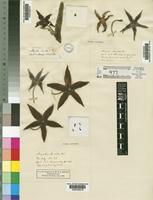
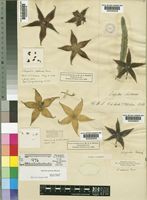
Stapelia asterias

13 Images see all

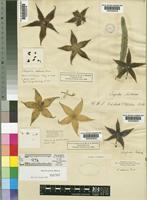
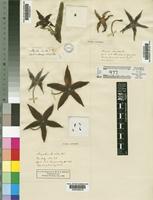
Stapelia asterias Masson [family ASCLEPIADACEAE]
Stapelia asterias Masson
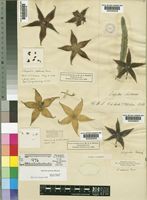
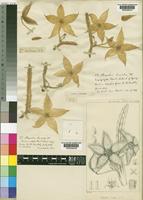
Stapelia asterias Masson [family ASCLEPIADACEAE]
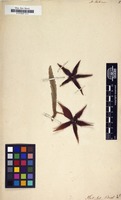
Filed as Stapelia asterias [family ASCLEPIADACEAE]
Stapelia asterias Masson [family ASCLEPIADACEAE]
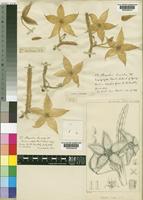
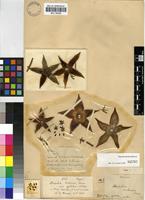
Type of Stapelia asterias Masson var. gibba N.E.Br. [family APOCYNACEAE]
Stapelia asterias Masson [family ASCLEPIADACEAE]
Stapelia asterias Masson
Stapelia asterias Masson [family ASCLEPIADACEAE]
Previous
Next

Name

Identification
Stapelia asterias Masson [family APOCYNACEAE ]
Related name
  • Stapelia asterias

Flora

Entry for STAPELIA Plantii Hook. f. [family ASCLEPIADACEAE]
Herbarium
Royal Botanic Gardens, Kew (K)
Collection
Flora Capensis
Resource Type
Reference Sources
Entry From
Flora Capensis, Vol 4, page 518, (1909) Author: By N. E. BROWN.
Names
STAPELIA Plantii Hook. f. [family ASCLEPIADACEAE], Bot. Mag. t. 5692;—Fl. des Serres, xix. 137, t. 2012.
STAPELIA Asterias [family ASCLEPIADACEAE], Journ. Hort. ser. 3, xl. 53, fig. 10, not of Masson.
Information
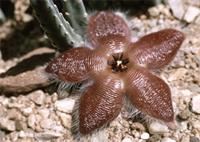
stems rather compact, 6–8 in. high, 3/4– 7/8 in. square when fully developed, with the angles much compressed, shortly toothed, pubescent, green; rudimentary leaves about 1 lin. long, erect; flowers 1–3 together at the base of the stems, developing successively; pedicels 1–1 1/4 in. long, 2 lin. thick, pubescent; sepals about 5 lin. long, lanceolate-attenuate, pubescent; corolla 4 1/2–5 in. in diam. with the lobes extended, minutely pubescent on the back; inner surface transversely rugose, thinly covered with short erect purple hairs on the disk, glabrous on the lobes, which are about 1 3/4 in. long and 1 in. broad, lanceolate, acuminate, abruptly recurved at about 1/3 above their base, thickly ciliate to their tips with long purple hairs, half of them directed inwards, dark purple-brown, more intense at the tips, with transverse irregular and often forked pale lemon-yellow lines (summits of the ridges) on the basal 2/3 of the lobes; disk flattish with a slight central depression; outer corona-lobes ascending-spreading, straight, not recurved at the tips, about 2 1/2 lin. long, linear, deeply concave-channelled down the face, more or less 3-toothed at the apex, with the lateral teeth rounded, sometimes unequal and the middle tooth shortly subulate, blackish-purple, passing into dull orange at the base, minutely pubescent with blackish hairs on the middle tooth and down the middle of the back; inner corona-lobes blackish-purple, with the dorsal wing sometimes entirely adnate to and much shorter than the triquetrous-subulate acute erectly spreading and but slightly recurved inner horn, sometimes adnate for 1/2– 1/3 of its length and produced above into a broad oblong free wing, more or less denticulate at the oblique obtuse apex and not much shorter than the inner horn, glabrous. null
Distribution
SOUTH AFRICA without locality, cultivated specimen!
Notes
Described from a living plant sent by Mr. Tuck of Grahamstown to Kew in 1866, without indication of locality. It has not been rediscovered and no specimen was preserved, but there are excellent drawings of it at Kew.

Related Materials

  • Terms and Conditions
  • Privacy Policy
  • Cookie Policy
  • Cookie Settings
  • Accessibility
  • Help
  • Contact Us
  • Facebook
  • Twitter
ITHAKA

JSTOR is part of ITHAKA, a not-for-profit organization helping the academic community use digital technologies to preserve the scholarly record and to advance research and teaching in sustainable ways.

©2000-2026 ITHAKA. All Rights Reserved. JSTOR®, the JSTOR logo, JPASS®, Aluka®, and ITHAKA® are registered trademarks of ITHAKA.

╳