JSTOR Global Plants Home
  • Home
  • Browse
  • About
  • Access
  • Account
    • Saved Items
    • Profile
  • Log in

Global Plants

Skip to Main Content
  • JSTOR Global Plants Home
  • Global Plants

    • Browse
    • About
    • Access
    • Account
      • Saved Items
      • Profile
Log in
  • Browse
  • About
  • Access
  • Account
    • Saved Items
    • Profile
Advanced Search

Compilation
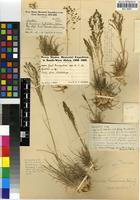
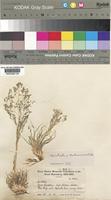
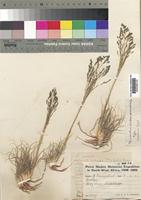
Sporobolus sladenianus

3 Images see all

Type of Sporobolus sladenianus F.Bolus [family POACEAE]
Syntype of Sporobolus sladenianus F.Bolus [family POACEAE]
Previous
Next

Name

Identification
Sporobolus sladenianus F.Bolus [family POACEAE ] Verified by Not on sheet, Sporobolus nervosus Hochst. [family POACEAE ] (stored under name); Verified by Not on sheet,
Related name
  • Sporobolus nervosus
  • Sporobolus sladenianus

Flora

Entry for SPOROBOLUS nervosus Hochst. [family POACEAE]
Herbarium
Royal Botanic Gardens, Kew (K)
Collection
Flora of Tropical East Africa
Resource Type
Reference Sources
Entry From
Flora of Tropical East Africa, Part (Part 2), page 177, (1974) Author: W. D. CLAYTON, S. M. PHILLIPS AND S. A. RENVOIZE
Names
SPOROBOLUS nervosus Hochst. [family POACEAE], in Flora 38: 202 (1855); Clayton in F.W.T.A., ed. 2, 3: 410 (1972). Type: Ethiopia, Agau, Gurrsarfa, Schimper in Herb. Buchinger 1309 (P, iso.!)
Vilfa nervosa (Hochst.) Schweinf. [family POACEAE], Beitr. Fl. Aethiop.: 303 (1867)
Sporobolus longibrachiatus Stapf [family POACEAE], in K.B. 1907: 219 (1907); G.T.: 48 (1965). Type: Somali Republic (N.), Appleton (K, holo. !)
Sporobolus lampranthus Pilg. [family POACEAE], in E.J. 48: 345 (1912). Type: South West Africa, Bull-sport Flats, Dinter 2135 (whereabouts uncertain, not B, PRE)
Sporobolus sladenianus Bolus [family POACEAE], in Ann. S. Afr. Mus. 9: 236 (1915). Types: South West Africa, Schakalskuppe, Pearson 4779 & Narudas Süd to Krai Kluft, Pearson 8103 (both K, isosyn. !)
Sporobolus eichingeri Mez [family POACEAE], in F.R. 17: 293 (1921); F.D.O.-A. 1: 290 (1931). Type: Tanzania, Lushoto District, Buiko, Eichinger 3366 (B, holo., K, photo. !); the type sheet bears 3 panicles of S. nervosus and the basal parts of S. cordofanus
Information
Densely caespitose perennial, or with the shoots contiguous from the closely spaced nodes of a short oblique rhizome; basal sheaths yellowish, indurated, often covered by the fibrous remains of decaying sheaths; culms 15–20 cm. high, erect. Leaf-blades flat, or more often convolute, 4–10 cm. long, 1–3 mm. wide, the tip filiform. Panicle narrowly ovate, 7–20 cm. long, secondarily branched, the branches bare below and the spikelets secund and clustered at the tips of the branchlets. Spikelets (1.5–)1.7–2.l mm. long, scaberulous or smooth, pallid greyish green to dark green; lower glume lanceolate, 0.8–1 mm. long, acute; upper glume narrowly ovate, (0.9–)1.3–1.9 mm. long, 2/3–4/5 as long as the spikelet, acute; lemma narrowly ovate, as long as the spikelet; anthers 3, 0.8–1 mm. long. Grain ellipsoid, 0.6 mm. long. Fig. 102.
Range
DISTR. K1, 3, 4, 6; T2, 3, 5 Mauritania, through Ethiopia and the Somali Republic to Arabia, also in South West Africa
Altitude range
300–1700 m.
Distribution
KENYA Meru District 24 km. NE. of Isiolo, 11 Dec. 1960, D. R. Stewart 495 !KENYA Masai District 40 km. on Nairobi–Magadi road, 20 July 1947, Bogdan 908 ! & 11 km. from Ol Tukai towards Namanga, 14 Dec. 1959, Verdcourt 2561 !TANZANIA Masai District Olbalbal, 28 Apr. 1958, Paulo 402 ! & 40 km. Arusha–Dodoma, Leippert 5770 !TANZANIA Arusha District N. of Ol Doinyo Sambu, 28 Dec. 1961, Greenway 10409 !
Notes
The species may be distinguished from 31, S. fimbriatus and 35, S. confinis by its clustered spikelets, narrow leaf-blades and caespitose habit with horny or fibrous basal sheaths. There is also a resemblance to 30, S. angustifolius which has the spikelets ± secund on the primary branches of the panicle and, in general, longer spikelets with a relatively short upper glume.

Related Materials

  • Terms and Conditions
  • Privacy Policy
  • Cookie Policy
  • Cookie Settings
  • Accessibility
  • Help
  • Contact Us
  • Facebook
  • Twitter
ITHAKA

JSTOR is part of ITHAKA, a not-for-profit organization helping the academic community use digital technologies to preserve the scholarly record and to advance research and teaching in sustainable ways.

©2000-2026 ITHAKA. All Rights Reserved. JSTOR®, the JSTOR logo, JPASS®, Aluka®, and ITHAKA® are registered trademarks of ITHAKA.

╳