JSTOR Global Plants Home
  • Home
  • Browse
  • About
  • Access
  • Account
    • Saved Items
    • Profile
  • Log in

Global Plants

Skip to Main Content
  • JSTOR Global Plants Home
  • Global Plants

    • Browse
    • About
    • Access
    • Account
      • Saved Items
      • Profile
Log in
  • Browse
  • About
  • Access
  • Account
    • Saved Items
    • Profile
Advanced Search

Compilation
Sphaeranthus sphenocleoides

3 Images see all

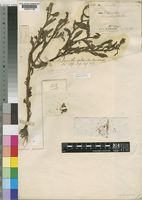
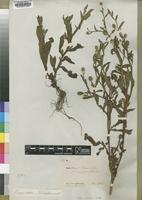
Sphaeranthus africanus L. [family COMPOSITAE]
Isotype of Sphaeranthus sphenocleoides Oliv.&Hiern [family ASTERACEAE]
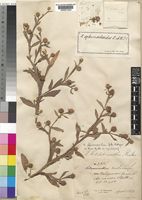
Sphaeranthus africanus L. [family COMPOSITAE]
Previous
Next

Name

Identification
Sphaeranthus africanus L. [family ASTERACEAE ] (stored under name); Isotype of Sphaeranthus sphenocleoides Oliv.&Hiern [family ASTERACEAE ]
Related name
  • Sphaeranthus africanus
  • Sphaeranthus indicus
  • Sphaeranthus sphenocleoides
  • Sphaeranthus hildebrandtii

Flora

Entry for SPHAERANTHUS africanus L. [family COMPOSITAE]
Herbarium
Royal Botanic Gardens, Kew (K)
Collection
Flora of Tropical East Africa
Resource Type
Reference Sources
Entry From
Flora of Tropical East Africa, page 315, (2002) Author: H.J. BEENTJE
Names
SPHAERANTHUS africanus L. [family COMPOSITAE], Sp. Pl. ed. 2: 1314 (1763); Robyns in K.B. 1924: 196 (1924); Ross-Craig in Hook., Ic. Pl. ser. 5, 6: 18, t. 3501a (1954); Humbert, Fl. Madag. 189: 376 (1962); Wild in Kirkia 12: 99 (1980); Lisowski in F.A.C. Compositae, Inuleae: 217 (1989). Type: “Africa” (no type designated)
SPHAERANTHUS microcephalus Vatke [family COMPOSITAE], in Oest. Bot. Zeitschr. 25: 326 (1875), non Willd., Sp. Pl. 3: 2395 (1804). Type: Tanzania, Zanzibar, Hildebrandt 1021 (B†, holo., K!, iso.)
SPHAERANTHUS sphenocleoides Oliv. & Hiern [family COMPOSITAE], in F.T.A. 3: 333 (1877). Type: Tanzania, Zanzibar, Hildebrandt s.n. (ubi?)
Information
Herb 0.5–1 m high; stems simple or branched, the branches winged; wings entire or denticulate, glabrous or pubescent. Leaves narrowly elliptic or obovate, 2–10 cm long, 0.8–3.2 cm wide, but lower stem leaves may grow to 15 cm long and 5 cm wide, base decurrent into the wings, margins subentire or denticulate, apex rounded to subacute, pubescent to almost glabrous, glandular and slightly aromatic. Glomerule greenish white, ellipsoid to globose, 7–13 mm long, 7–13 mm across, occasionally double, the individual capitula distinct; capitulum stalk 5–30 mm long; receptacle globose to ellipsoid; glomerule bracts linear to lanceolate and 2.5–4 mm long, 0.3 mm wide, acute to acuminate, glandular-puberulous, the lowermost bracts hidden at anthesis; capitula borne on a short secondary receptacle, with 6–15 bracts, these oblanceolate, 1.5–3 mm long, apiculate to rounded, sparsely glandular. Florets: outer florets 15–40, tube ovoid to broadly cylindrical and corky, abruptly narrowed into a filiform tube, 0.7–0.9 mm long, glabrous, minutely toothed distally, style 0.8–1 mm long; inner florets 1–3, tube inflated and corky but abruptly constricted below the lobes and there sparsely glandular, 0.7–1 mm long, lobes 0.3–0.5 mm long, sparsely glandular, anthers 0.6–0.8 mm long, style 1.7–2.8 mm long, briefly bifid. Achenes cylindrical, 0.4–0.6 mm long, puberulous and glandular, briefly stalked on a white glabrous stipe.
Range
DISTR. K 7; T 3, 6, 8; Z; P southern Asia and Australia
Altitude range
1–450 m
Distribution
KENYA Kwale District Shimba Hills, Longomwagandi, Feb. 1968, Magogo & Glover 159! & Mwele, Oct. 1991, Luke 2938!TANZANIA Tanga District Magunga Halt, Dec. 1960, Semsei 3133!;KENYA Tana R. District Tana R. Primate Reserve, Mar. 1990, Tana R. Primate Res. Exp. 517!TANZANIA Uzaramo District Kibaha, Nov. 1970, Harris & Harris 5409!;TANZANIA Kilwa District Kingupira, June 1975, Vollesen MRC 2428!TANZANIA Pemba Chake Chake, Aug. 1929, Vaughan 558!
Distribution (external)
; Mozambique
Madagascar
Notes
Lisowski in F.A.C. Compositae, Inuleae: 217 (1989) cites specimens of this taxon from Congo (Kinshasa): I have not seen these specimens but it seems unlikely this coastal taxon would occur so far inland.

Related Materials

  • Terms and Conditions
  • Privacy Policy
  • Cookie Policy
  • Cookie Settings
  • Accessibility
  • Help
  • Contact Us
  • Facebook
  • Twitter
ITHAKA

JSTOR is part of ITHAKA, a not-for-profit organization helping the academic community use digital technologies to preserve the scholarly record and to advance research and teaching in sustainable ways.

©2000-2026 ITHAKA. All Rights Reserved. JSTOR®, the JSTOR logo, JPASS®, Aluka®, and ITHAKA® are registered trademarks of ITHAKA.

╳