JSTOR Global Plants Home
  • Home
  • Browse
  • About
  • Access
  • Account
    • Saved Items
    • Profile
  • Log in

Global Plants

Skip to Main Content
  • JSTOR Global Plants Home
  • Global Plants

    • Browse
    • About
    • Access
    • Account
      • Saved Items
      • Profile
Log in
  • Browse
  • About
  • Access
  • Account
    • Saved Items
    • Profile
Advanced Search

Compilation
Spermacoce confusa

7 Images see all

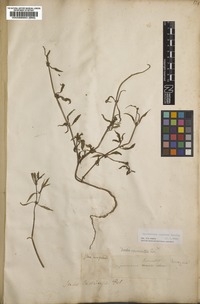
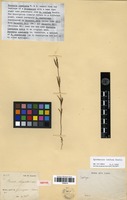
Filed as Spermacoce confusa Rendle [family RUBIACEAE]
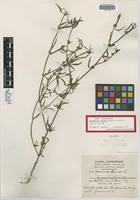
Isolectotype of Spermacoce confusa Rendle [family RUBIACEAE]
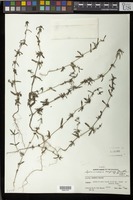
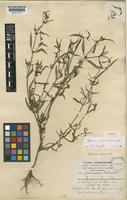
Filed as Spermacoce confusa Rendle [family RUBIACEAE]
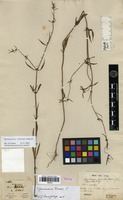
Isotype of Borreria longiseta M.Martens & Galeotti [family RUBIACEAE]
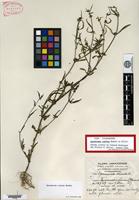
Spermacoce confusa Rendle ex Gillis [family RUBIACEAE]
Type of Spermacoce confusa Rendle ex Gillis [family RUBIACEAE]
Previous
Next

Name

Identification
Spermacoce confusa Rendle [family RUBIACEAE ] (stored under name); Verified by Charles Dennis Adams, Spermacoce tenuior L. [family RUBIACEAE ] Verified by Daniel Carl Solander,
Related name
  • Spermacoce tenuior
  • Spermacoce confusa

Flora

Entry for SPERMACOCE confusa Gillis [family RUBIACEAE]
Herbarium
Royal Botanic Gardens, Kew (K)
Collection
Flora of Tropical East Africa
Resource Type
Reference Sources
Entry From
Flora of Tropical East Africa, page 1, (1976) Author: B. VERDCOURT
Names
SPERMACOCE confusa Gillis [family RUBIACEAE], in Phytologia 29: 185 (1974). Type: Jamaica, Lower Clarendon Parish, Inverness, W. Harris 12749 (BM, holo.!, GH, NY, iso.)
SPERMACOCE tenuior [family RUBIACEAE], [sensu Gaertn., Fruct. & Sem. 1: 122, t. 25/9 (1788) et auctt. mult. non L. (Rendle gives full list of refences where misapplied)]
Information
Annual herb 30–90 cm. tall, with generally erect angled stems, the angles mostly rather rough, often with very short stiff papilla-like hairs, particularly just below the nodes. Leaf-blades linear-lanceolate to narrowly elliptic, 2.5–5 cm. long, 0.2–1.3 cm. wide, acute or acuminate at the apex, cuneate at the base, shortly to densely scabrid above and on the nerves beneath; petiole very short; stipule-sheath ± 1 mm. long, with several fimbriae 1–2 mm. long. Calyx-tube narrowly turbinate, 1.5 mm. long; lobes triangular, ± 0.5 mm. long. Corolla white, white and pink or pale mauve; tube ± 1.5 mm. long; lobes ovate, ± 0.5 mm. long. Capsule ellipsoid to subglobose, 2–2.5 mm. long, 1.5 mm. wide, finely wrinkled striate, glabrous to densely hairy, crowned with the short calyx-lobes. Seeds dark chestnut-brown, narrowly ellipsoid, 1.6–1.8 mm. long, 0.8 mm. wide, scarcely pitted (fide Rendle), very distinctly reticulate-foveolate (in African material).
Range
DISTR. T3; Z; P and tropical America
Altitude range
0–800 m.
Distribution
TANZANIA Lushoto District Sigi Railway Station, 7 Mar. 1917, Peter 56010! & Sigi to Mpandeni [Pandeni], 29 May 1917, Peter 56032! & Derema to Longusa, 12 May 1918, Peter 56127!TANZANIA Zanzibar I., Mwera Swamp, 16 Nov. 1930, Vaughan 1682!TANZANIA Pemba I., Chake Chake, 27 Aug. 1929, Vaughan 591!
Distribution (external)
SE. U.S.A
Bahamas
W. Indies
Trindad
Notes
Bremekamp has annotated Vaughan 591 as Diodia ocimifolia (Roem. & Schultes) Bremek. (Hemidiodia ocimifolia (Roem. & Schultes) K. Schum.), but the corolla, glabrous stipule fimbriae, stiff stem hairs and ± glabrescent capsules with a different dehiscence are not correct for that species, although the general habit is extremely similar. Since it is a widespread weed it could easily occur.No recent material of S. confusa has been seen from the Flora area although A. Peter, collected 9 specimens, most of which he annotated as Borreria aspera A. Peter, a name which has never been published. None of this material is typical of S. confusa as it occurs in the West Indies where the capsules are mostly densely hairy. The African material has almost or quite glabrous capsules and even the leaves are only sparsely hairy above, moreover the seeds are more strongly foveolate. Nevertheless similar specimens do occur in America and presumably the original introduction was atypical. I am, however, not altogether convinced that S. confusa and S. tenuior are as distinct as claimed by Rendle.

Related Materials

  • Terms and Conditions
  • Privacy Policy
  • Cookie Policy
  • Cookie Settings
  • Accessibility
  • Help
  • Contact Us
  • Facebook
  • Twitter
ITHAKA

JSTOR is part of ITHAKA, a not-for-profit organization helping the academic community use digital technologies to preserve the scholarly record and to advance research and teaching in sustainable ways.

©2000-2026 ITHAKA. All Rights Reserved. JSTOR®, the JSTOR logo, JPASS®, Aluka®, and ITHAKA® are registered trademarks of ITHAKA.

╳