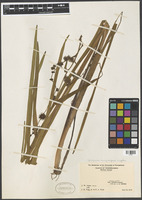
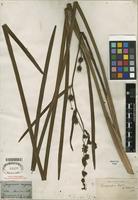
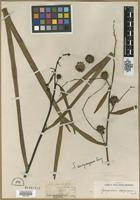
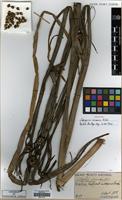
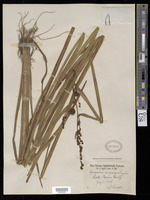
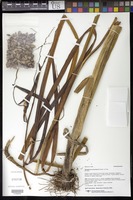
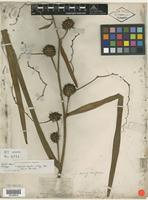
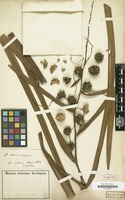
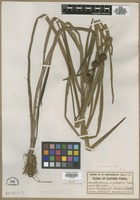
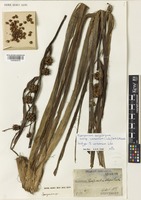
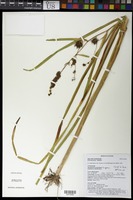
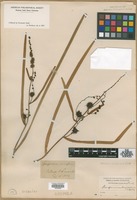
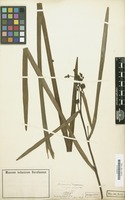
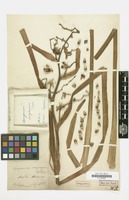
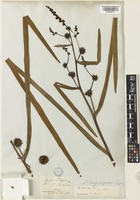
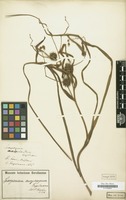
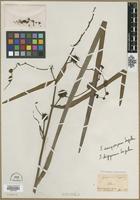
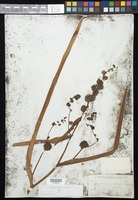
Sparganium eurycarpum grows mostly near the coast (but not in salt marshes) in New England (G. E. Crow and C. B. Hellquist 1981), mostly in the interior in British Columbia (T. C. Brayshaw 1985), and in coastal and interior sites from Washington to Baja California. It is locally common to abundant in fresh to somewhat brackish waters across the continent but is less frequent toward its northern and southern limits.
Both stigmas of bistigmatic flowers often persist on the fruits, but sometimes one or both break away. The fruits of bistigmatic and 2-ovuled flowers are often larger than those of unistigmatic flowers.
From southern British Columbia to Baja California, especially near the coast but also at scattered sites inland, some plants having fewer bistigmatic flowers and smaller, rounded or tapering fruits have been called Sparganium eurycarpum var. greenei (Morong) Graebner or S. greenei Morong by some authors (e.g., H. L. Mason 1957; T. C. Brayshaw 1985) but not by others (e.g., C. L. Hitchcock 1969et al. 1955--1969, vol. 1; J. L. Reveal 1977A. Cronquist et al. 1972+, vol. 6). Such plants were placed in S. erectum Linnaeus, the strongly polymorphic and ecotypically variable Eurasian vicariant species, as S. erectum subsp. stoloniferum (Hamilton ex Graebner) C. D. K. Cook & M. S. Nicholls (C. D. K. Cook and M. S. Nicholls 1987). Sparganium eurycarpum is only weakly distinguished from S. erectum, largely on the basis of relative preponderance of bi- and unistigmatic flowers (± 50% in the two species, respectively), and by concomitant differences in fruit size and shape. In North America, however, some unistigmatic flowers occur among bistigmatic flowers on pistillate heads of many plants throughout the range of S. eurycarpum. Such unistigmatic flowers are common on some west-coast plants and on plants of alkaline marshes of the Great Basin and Great Plains, although there is considerable variation in all three areas. Because of these widespread variations, and in the absence of definitive, rangewide, comparative studies, our plants are here treated as S. eurycarpum. Comparative studies of Eurasian and North American plants, however, perhaps would show that all are best treated as S. erectum, the name with priority, but no such studies have been made.