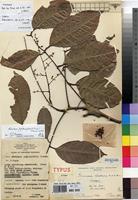
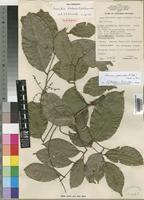
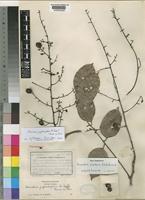
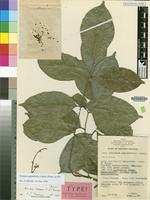
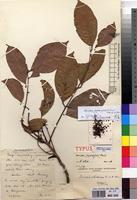
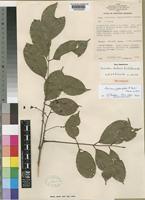
Scrambling shrub 4 m. high or small tree up to 9 m. tall. Leaves usually 7–9-foliolate; petiole and rhachis 16–35 cm. long, terete, not much thickened; leaflets light green, subconcolorous, papyraceous to subcoriaceous, glabrous, contracted at the apex into a rather narrow acumen up to 1·8 cm. long, a little thickened and undulate at the margin, broadly elliptic to ovate, the terminal one up to 14·3 × 7·8 cm., symmetric at the base, the lateral ones up to 14 × 7 cm., symmetric or asymmetric, all rounded or somewhat cuneate at the base and with petiolule 0·5–1 cm. long, not much thickened, canaliculate, not wrinkled; lateral nerves and the narrow reticulation slightly raised above, more so below; tertiary nerves collected in an oblique one directed towards the lateral nerve-axil. Panicles 7–34 cm. long, terminal and axillary, much branched; pedicels up to 2 mm. long; flower-bud purple-red, globose, obtuse. Male flower: calyx c. 2·5 × 3·5 mm., very shallowly lobulate; petals pink edged with cream outside, cream inside, c. 4 × 2 mm., oblong, acute, very fleshy, not thickened at the apex; stamens 12–16; filaments 0·75 mm. long; anthers 2 mm. long, oblong, apiculate. Female flowers: calyx 2·5 × 3 mm., glabrous, cupuliform; petals as in the male flower but narrower; staminodes 5, c. 2 mm. long; ovary 1·75 mm. in diam., glabrous, ovoid, attenuate into a style 1–1·5 mm. long. Drupe orange to red, c. 2 × 1·2 cm., ellipsoid.