JSTOR Global Plants Home
  • Home
  • Browse
  • About
  • Access
  • Account
    • Saved Items
    • Profile
  • Log in

Global Plants

Skip to Main Content
  • JSTOR Global Plants Home
  • Global Plants

    • Browse
    • About
    • Access
    • Account
      • Saved Items
      • Profile
Log in
  • Browse
  • About
  • Access
  • Account
    • Saved Items
    • Profile
Advanced Search

Compilation
Sorghum versicolor

3 Images see all

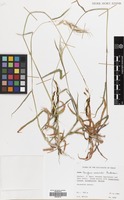
Filed as Sorghum versicolor Andersson [family GRAMINEAE]
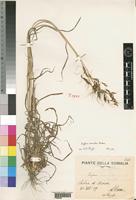
Holotype of Sorghum purpureo-sericeum (Hochst. ex A.Rich.) Asch. & Schweinf. var. trinervatus Chiov. [family GRAMINEAE]
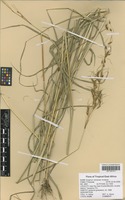
Filed as Sorghum versicolor Andersson [family POACEAE]
Previous
Next

Name

Identification
Sorghum versicolor Andersson [family GRAMINEAE ] (stored under name); Verified by Data not digitized, Sorghum purpureo-sericeum (Hochst. ex A.Rich.) Asch. & Schweinf. [family GRAMINEAE ] Verified by Data not digitized,
Related name
  • Sorghum purpureo-sericeum
  • Sorghum versicolor

Flora

Entry for SORGHUM versicolor Anderss. [family POACEAE]
Herbarium
Royal Botanic Gardens, Kew (K)
Collection
Flora Somalia
Resource Type
Reference Sources
Entry From
Flora Somalia, Vol 4, (1995) Author: by T. A. Cope [updated by M. Thulin 2008]
Names
SORGHUM versicolor Anderss. [family POACEAE], (1863).
SORGHUM purpureo-sericeum Chiov. var. trinervatum [family POACEAE], Fl. Somala 2: 439 (1932);. type: S3, “Osboda”, Senni 244 (FT holo.).
Information
Annual or short-lived perennial up to 2.5 m high, without rhizomes, the nodes densely bearded. Panicle narrowly oblong, 5–25 cm long; primary branches whorled, simple (rarely the longer branched), bearing 3–7 spikelet-pairs. Sessile spikelet elliptic-oblong, 5–7 mm long; lower glume coriaceous, glossy, glabrous to loosely hairy, bearded from the callus; upper lemma with an awn 25–40 mm long. Pedicelled spikelet linear to lanceolate, 3–5 mm long.
Range
S3 Ethiopia and Kenya southwards to South Africa.
Altitude range
Coastal
Distribution
SOMALIA Kazmi 5167.

Related Materials

  • Terms and Conditions
  • Privacy Policy
  • Cookie Policy
  • Cookie Settings
  • Accessibility
  • Help
  • Contact Us
  • Facebook
  • Twitter
ITHAKA

JSTOR is part of ITHAKA, a not-for-profit organization helping the academic community use digital technologies to preserve the scholarly record and to advance research and teaching in sustainable ways.

©2000-2026 ITHAKA. All Rights Reserved. JSTOR®, the JSTOR logo, JPASS®, Aluka®, and ITHAKA® are registered trademarks of ITHAKA.

╳