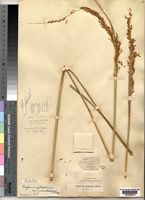
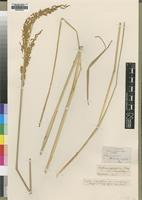
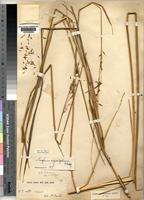
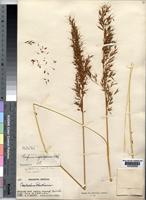
Perennial (?). Culms erect, apparently simple and tall (over 4 ft. high), somewhat stout, 4–6-noded, upper internodes exserted, smooth, glabrous. Leaf-sheaths terete, rather tight, firm, striate, smooth, glabrous except at the appressedly bearded nodes, produced into short auricles along the ligule; ligules firm, scarious, from very short to 1 lin. long, more or less hairy from the back, glabrescent; blades linear, rather shortly tapering to a hard point, hardly narrowed at the base, very variable in length, up to 1 1/2 ft. long and 3 lin. wide, flat or involute, firm and rigid, glabrous, smooth except on the upwards very scabrid margins, midrib usually slender, lateral nerves numerous, very close. Panicle erect, narrow, up to 1 ft. long; rhachis smooth, glabrous or with a few hairs at the nodes; branches semiverticillate, in dense fascicles from the nodes, very unequal, the longest up to 4 in. long, divided from near the base, up to 8-noded, the longest branchlets divided again, filiform to capillary, more or less flexuous, smooth, glabrous, tips discoid-clavate. Racemes 4–1-noded; each sessile spikelet except the uppermost accompanied by 1 empty pedicel, the uppermost (or in 1-noded racemes the solitary spikelet) by 2 empty pedicels; joints and pedicels finely filiform, ciliate, cilia 1/2 lin. long; joints 2–2 1/2 lin. long; pedicels 1 1/2–2 lin. long. Spikelets oblong to lanceolate-oblong, obtuse to subacuminate, 2 1/2–3 lin. long, brown with pale tips. Glumes equal, subcoriaceous to coriaceous; lower truncate, loosely hairy on the back, rigidly ciliolate at the subterminal keels and tips, finely 9-nerved; upper very similar, 5-nerved. Valves of lower floret broad-oblong, 2 lin. long, minutely ciliolate from the middle, 2-nerved; of upper oblong, eciliolate or almost so, 1 3/4 lin. long, 3-nerved, lobes almost wholly adnate to the awn; awn 4–7 lin. long, very slender, kneed at and twisted below the middle. Lodicules glabrous. Anthers 1 1/2–2 lin. long.