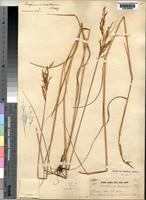
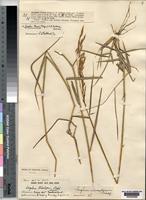
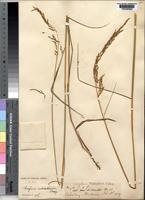
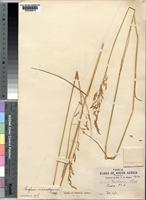
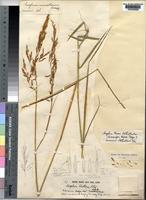
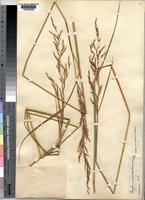
Perennial, tufted, up to 3 ft. high. Culms erect, rather slender, smooth, glabrous. Leaf-sheaths glabrous except at the appressedly bearded nodes, or the lowest and those of the innovation-shoots sparingly hairy towards the mouth, smooth, mostly shorter than the internodes; ligules short, scarious, slightly pubescent and ciliolate; blades linear; of the lowest leaves and the innovations short, 1–3 in. long; of the upper much elongated and tapering to a long fine point, up to 7 in. long, 2–2 1/2 lin. wide, rather rigid, flat or convolute, pale dull green, smooth below, somewhat rough above, glabrous, rarely with a few scattered hairs, closely nerved. Panicle linear to linear-oblong, erect, often more or less secund, 6–9 in. long; rhachis smooth, glabrous; branches semiverticillate, 2–4 from a node, unequal, the longest up to 2 rarely 3 or even 4 in. long and 3–4-noded, filiform, divided only once, that is the branchlets of the first order which are hairy below their tips bearing the 4–1-noded racemes; each sessile spikelet except the uppermost accompanied by an empty pedicel, the uppermost (or in 1-noded racemes the solitary spikelet) by two empty pedicels; joints and pedicels alike, finely filiform, ciliate, cilia up to almost 1 lin. long, often purplish, joints 2–2 1/2 lin. long, pedicels 1 1/2–2 lin. long. Spikelets linear-lanceolate, acuminate, 2 1/2–4 lin. long, pale brown; glumes subequal, chartaceous, lower minutely truncate, loosely villous on the back, with the hairs often purplish, finely 9-nerved, upper similar but slightly longer, 5-nerved; valves 2 1/2–3 lin. long; of lower floret lanceolate-oblong, minutely ciliate upwards, 2-nerved; of upper floret oblong, ciliolate upwards, 3-nerved, lobes almost wholly adnate to the awn which is 2–3 lin. long, very slender, slightly twisted below the middle. Lodicules very small and glabrous. Anthers over 2 lin. long. Pedicelled spikelets none or quite rudimentary and minute.