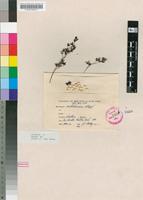
Mature panicles only known. Culms up to 5 lin. across at the base of the panicles. Panicle erect, contracted, somewhat loose, oblong, secund, almost 1 ft. by 4 in.; branches more or less whorled, often many in a whorl, ascending, arched and ultimately somewhat nodding, slender, like the branchlets purple, spinulously ciliolate, with white cilia towards the base and villous at the nodes, lowest branches divided almost from the base, following (longest) up to 4 1/2 in. long and undivided for 1–1 1/2 in. from the base. Racemes tough, 3-noded, up to over 1/2 in. long, loose and loosely arranged; joints slender, up to 2 1/2 lin. long, purple, densely or sparingly and shortly white-ciliate; pedicels similar, 1/2–1 lin. long. Sessile spikelet oblong in flower, ellipsoid and gaping in fruit, up to 3 1/2 lin. long, glossy jet black, sometimes with red tips; callus-beard dense below the lower, scanty below the upper glume or altogether scanty and ultimately disappearing. Glumes equal, crustaceous with brittle tips, opaque, margins membranous, reddish, at length flattened out; lower about 13-nerved with few transverse veins, very finely 2-keeled below the tip, nerves very fine, faintly raised, whitish-strigillose or pubescent particularly above the middle, or almost glabrous; upper about 11-nerved, faintly keeled all along, much narrower than the lower. Valves conspicuously ciliate; lower oblong, 3 lin. long, tinged with red; upper over 2 lin. long, ovate, entire, minutely mucronate. Anthers 2 lin. long. Grain obovoid-ellipsoid, much exposed between the widely gaping appressed glumes, 2 1/2 lin. by nearly 2 lin., more or less compressed, biconvex, milk-white; embryo-mark as in S. papyrascens. Pedicelled spikelet ♂ or neuter, more or less persistent, straw-colour more or less tinged with claret, lower glume about 13-, upper 11-nerved.