

Compilation
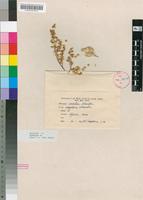
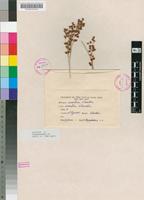
Sorghum exsertum
2 Images see all
Name
Identification
Sorghum exsertum Snowden [family POACEAE ] Verified by Not on sheet, Sorghum bicolor (L.) Moench [family POACEAE ] (stored under name); Verified by Not on sheet,
Related name
- Sorghum bicolor
- Sorghum exsertum
Common name
- guinea-corn; sweet sorghum (S. mellitum var. mellitum sensu Snowden); Sierra Leone guinea-corn (S. margaritiferum sensu Snowden)., Burkill, H.M. 1985. The useful plants of west tropical Africa, Vol. 2
- tòl-lε (FCD) (SIERRA LEONE, BULOM), Burkill, H.M. 1985. The useful plants of west tropical Africa, Vol. 2
- gros mil; sorgho; tigne; tègne (S. margaritiferum sensu Snowden)., Burkill, H.M. 1985. The useful plants of west tropical Africa, Vol. 2
- thч̀l (Pichl) (SIERRA LEONE, BULOM (Sherbro)), Burkill, H.M. 1985. The useful plants of west tropical Africa, Vol. 2
Information
Entry for Sorghum bicolor (Linn.) Moench, race guinea [family POACEAE]
Herbarium
Royal Botanic Gardens, Kew (K)
Collection
Useful Plants of West Tropical Africa
Resource Type
Reference Sources
Entry From
Burkill, H.M. 1985. The useful plants of west tropical Africa, Vol 2
Names
Sorghum bicolor (Linn.) Moench, race guinea [family POACEAE]
Sorghum exsertum var amplum Snowden [family POACEAE]
Sorghum gambicum Snowden [family POACEAE]
Sorghum guineense var involutum Stapf. [family POACEAE]
Sorghum margaritiferum Stapf [family POACEAE]
Sorghum mellitum var mellitum Snowden [family POACEAE]
Common names
English guinea-corn; sweet sorghum (S. mellitum var. mellitum sensu Snowden); Sierra Leone guinea-corn (S. margaritiferum sensu Snowden). French gros mil; sorgho; tigne; tègne (S. margaritiferum sensu Snowden). SIERRA LEONE: BULOM tòl-lε (FCD) BULOM (Sherbro) thч̀l (Pichl)
Description
Culms stout, 2–5 m high by 2–3 cm diameter, long loose panicle, often goose-necked; a race particularly of W Africa, widely distributed in The Gambia, Guinea, Sierra Leone and N Nigeria.A strain, 5. gambicum sensu Snowden, is the native guinea-corn of The Gambia and Mali. A black-glumed form of it is grown like rice in standing water near Timbuktu (1). The grain of another strain, S. margaritiferum sensu Snowden, is cooked and eaten like rice (2). Strains of S. mellitum have sweet culms. They are used in Ghana to make a sweetmeat called alewa: Hausa (4). A commercial strain developed in the USA is source of a thick golden brown syrup. The crushed culms after expression of the sweet sap are called ‘pummies’ and are considered a good soil conditioner and mulch (3).A strain grown in N Nigeria (S. exsertum var. amplum sensu Snowden) has red culm sheaths from which a red dye is extracted for dyeing leather (1).
References
Guinea corn, S. caudatum, f. colorans, sensu Snowden: $GUINEA ~KONYAGI vye-ntεli ve-ndyax (FG&G) vye-ntεli vyempalax (FG&G)$SIERRA LEONE ~FULA-PULAAR (Sierra Leone) gauri (FCD)$MALI ? (Lake Faguibine) djibi a black-glumed form (JMD)$DAHOMEY ? obo (Newton fide JMD)$NIGERIA ~GWARI dakwuhi (JMD) ewi dakwuhi (JMD)~NGIZIM ángàabà (pl. -àbín) (Schuh)Guinea corn, S. exertum, var. amplum, sensu Snowden: $TOGO ~TOBOTE edyi-pempε (JMD)$NIGERIA ~HAUSA zabakon к̉aura (JMD; ZOG)Guinea corn, S. gambicum sensu Snowden: $THE GAMBIA ~MANDING-MANDINKA basse ba kinto (JMD) bassiba (JMD) bassoba (JMD) ferdu basso (JMD) gajabo straight-necked form (JMD) kinto (JMD)$GUINEA ~MANDING-MANINKA nion-ni-fing = small black (JMD) nion-ni-gélé (JMD)$SIERRA LEONE ~FULA-PULAAR (Sierra Leone) gari (FCD)~KORANKO bimbεri (FCD)$MALI ~MANDING-BAMBARA bemberi (JMD) bemberi ba (JMD) keniki (JMD) sanko (JMD) suku late forms (JMD)~MANINKA nion-ni-fing = small black (JMD) nion-ni-gélé (JMD)$NIGERIA ~HAUSA kaso ba ni (JMD) kaso bammi (ZOG)Guinea corn, S. guineense sensu Snowden: $SENEGAL ~BEDIK gi-nìyál (FG&G) gi-nìyál ge-pεsyà (FG&G)~MANDING-BAMBARA bãgéné (JB)~SERER kõngosan (JB)$GUINEA ~BASARI dεlí fεsyàx (FG&G) dεlí wáràx (FG&G)$TOGO ~NAWDM dgefεlu (JMD) nyiamune (JMD)~TEM kansina (JMD) tyetya kulma (JMD)$NIGERIA ~HAUSA abantako (JMD) asniya (JMD) basharamba, bazamfara (JMD) doran zabo = hump of the guinea-fowl (JMD) doro = the hump (JMD) dungogiya a goose-necked form (JMD) fara-fara (JMD) farfara (JMD) haк̉orin karuwa = tooth of the prostitute; a form with both red and white grain in the same panicle (JMD) janare (JMD) janhauya (JMD) masaba (JMD) tan к̉wasau goose-necked forms (JMD) tankware goose-necked forms (JMD) wútsíyàr tunku = tail of the mongoose(JMD) yalan (JMD)Guinea corn, S. mellitum, var. mellitum, sensu Snowden: $SENEGAL ~WOLOF diahnât a goose-necked form (AS)$THE GAMBIA ~MANDING-MANDINKA sucar kalo (JMD)$NIGER ~DENDI kááná (indef. sing.) (Tersis)$NIGERIA ~FULA-FULFULDE (Nigeria) badal (pl. bade) (JMD) cibal (pl. cibe, cife) (JMB) cibal ngesa from ngesa: of the Geld (JMD) cife takanδari (JMD) lakaawal (pl. lakaaje) (JMD) lakatblel (JMD)~HAUSA kárán tálàkà = poor man’s cane (JMD; ZOG) tákàn δaá (auctt.)~IDOMA ẹmị́igwu (Armstrong)~KAMBARI-SALKA ttàkámù (pl. ìita-) (RB)~KANURI kàngálè sawadẻ (C&H) ngáwúrà (A&S) sabadẹ (JMD)~SURA ewùng (anon. fide KW)~YEDINA kanggeli aali (Lukas)References:1. Dalziel, 1937: 547. 2. De Wet, 1978: 480–1. 3. Hemmerly, 1983: 406–9. 4. Irvine, 1948: 265.
Contributor
Royal Botanic Gardens, Kew (K)