JSTOR Global Plants Home
  • Home
  • Browse
  • About
  • Access
  • Account
    • Saved Items
    • Profile
  • Log in

Global Plants

Skip to Main Content
  • JSTOR Global Plants Home
  • Global Plants

    • Browse
    • About
    • Access
    • Account
      • Saved Items
      • Profile
Log in
  • Browse
  • About
  • Access
  • Account
    • Saved Items
    • Profile
Advanced Search

Compilation
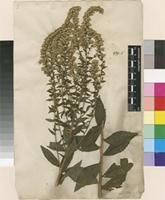
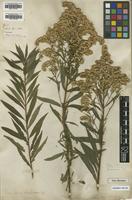
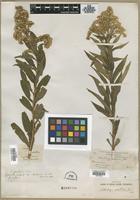
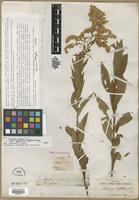
Solidago serotina

14 Images see all

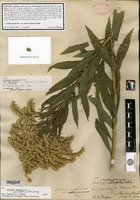
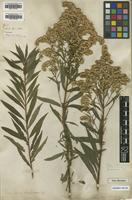
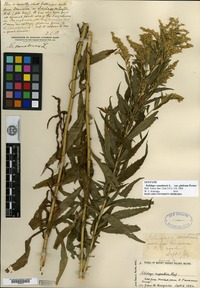
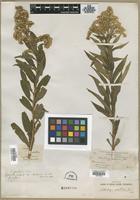
Type of Solidago serotina Aiton var. salebrosa Piper [family ASTERACEAE]
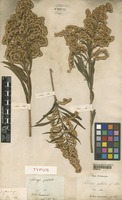
Type of Solidago glabra Desf. [family COMPOSITAE]
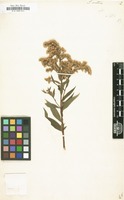
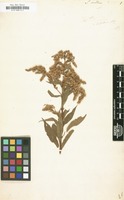
Filed as Solidago serotina [family COMPOSITAE]
Filed as Solidago serotina Retz. [family ASTERACEAE]
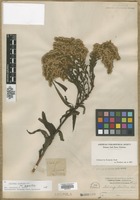
Syntype of Solidago serotina Ait. var. salebrosa Piper [family ASTERACEAE]
Type of Solidago serotina Aiton [family ASTERACEAE]
Filed as Solidago cuneifolia Nutt. [family ASTERACEAE]
Filed as Solidago serotina [family COMPOSITAE]
Filed as Solidago gigantea Aiton var. gigantea Rosend. & Cronquist [family ASTERACEAE]
Filed as Solidago pitcheri Nutt. [family ASTERACEAE]
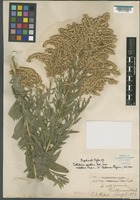
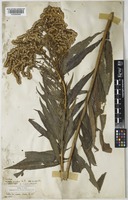
Type of Solidago serotina Aiton [family ASTERACEAE]
Solidago serotina Aiton [family COMPOSITAE]
Syntype of Solidago canadensis Linnaeus var. glabrata Porter [family ASTERACEAE]
Filed as Solidago cuneifolia Nutt. [family ASTERACEAE]
Previous
Next

Name

Identification
Solidago serotina Aiton [family ASTERACEAE ] (stored under name);
Related name
  • Solidago cuneifolia
  • Solidago serotina
  • Solidago rupestris
  • Solidago canadensis
  • Solidago altissima
  • Solidago pitcheri
Common name
  • Rocky Mountains Canada goldenrod, Flora of North America Vol. 20
  • verge d’or géante, Flora of North America Vol. 20
  • Tall or giant or smooth goldenrod, Flora of North America Vol. 20

Flora

Entry for Solidago lepida de Candolle var. salebrosa (Piper) Semple [family COMPOSITAE]
Herbarium
Flora of North America (FNA)
Collection
Flora of North America
Resource Type
Reference Sources
Entry From
Flora of North America, Vol 20,
Names
Solidago lepida de Candolle var. salebrosa (Piper) Semple [family COMPOSITAE], Sida, 20: 1611. 2003
Solidago serotina Aiton var. salebrosa Piper [family COMPOSITAE], in C. V. Piper and R. K. Beattie, Fl. Palouse Reg., 185. 1901
Solidago canadensis Linnaeus subsp. salebrosa (Piper) D. D. Keck [family COMPOSITAE]
Solidago canadensis var. salebrosa (Piper) M. E. Jones [family COMPOSITAE]
Solidago gigantea Aiton var. salebrosa (Piper) Friesner [family COMPOSITAE]
Solidago salebrosa (Piper) Rydberg [family COMPOSITAE]
Solidago serra Rydberg [family COMPOSITAE]
Treatment Author(s)
John C. Semple
Rachel E. Cook
Information
Heads in pyramidal paniculiform arrays, proximal branches arching to recurved. 2n = 18, 36, 54.
Phenology
aug (summer), sep-oct (fall)
Altitude range
0–2900+ m;
Distribution
USA Ariz.USA Colo.USA IdahoUSA Mont.USA Nev.USA N.Mex.USA UtahUSA Wash.USA Wyo.Canada Alta.Canada B.C.Canada Man.Canada Sask.
Discussion
Variety salebrosa strongly resembles Solidago canadensis, and is found throughout most of the Rocky Mountains in the United States and adjacent Canada. It has been included in S. canadensis by many authors (e.g., A. Cronquist 1994). In extreme forms the array is broader than tall with long, arching proximal branches. Hairier plants can be similar in appearance to S. altissima; the latter is usually not glandular and is much hairier. Glabrate plants of var. salebrosa can be difficult to distinguish from hexaploid S. gigantea near and in the mountains from Alberta south to New Mexico. Glabrate plants in the mountains often treated as S. gigantea are glandular and belong in S. lepida var. salebrosa. Small-headed diploids found in the Rocky Mountains from southern British Columbia to Colorado are usually sparsely glandular and could be confused with short-array forms of S. elongata.

Related Materials

  • Terms and Conditions
  • Privacy Policy
  • Cookie Policy
  • Cookie Settings
  • Accessibility
  • Help
  • Contact Us
  • Facebook
  • Twitter
ITHAKA

JSTOR is part of ITHAKA, a not-for-profit organization helping the academic community use digital technologies to preserve the scholarly record and to advance research and teaching in sustainable ways.

©2000-2026 ITHAKA. All Rights Reserved. JSTOR®, the JSTOR logo, JPASS®, Aluka®, and ITHAKA® are registered trademarks of ITHAKA.

╳