

Compilation
Solidago pitcheri
1 Images see all
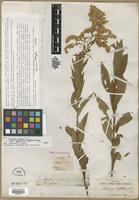
Name
Identification
Solidago pitcheri Nutt. [family ASTERACEAE ] (stored under name); Verified by Not on Sheet, Solidago serotina Aiton [family ASTERACEAE ] Verified by Not on Sheet, Solidago pitcheri Nutt. [family ASTERACEAE ] Verified by Not on Sheet,
Related name
- Solidago serotina
- Solidago pitcheri
Common name
- verge d’or géante, Flora of North America Vol. 20
- Tall or giant or smooth goldenrod, Flora of North America Vol. 20
Flora
Entry for Solidago gigantea Aiton [family COMPOSITAE]
Herbarium
Flora of North America (FNA)
Collection
Flora of North America
Resource Type
Reference Sources
Entry From
Flora of North America, Vol 20,
Names
Solidago gigantea Aiton [family COMPOSITAE], Hort. Kew., 3: 211. 1789
Aster latissimifolius (Miller) Kuntze var. serotinus Kuntze [family COMPOSITAE]
Doria dumetorum (Lunell) Lunell [family ]
Doria pitcheri (Nuttall) Lunell [family ]
Solidago cleliae de Candolle [family COMPOSITAE]
Solidago dumetorum Lunell [family COMPOSITAE]
Solidago gigantea var. leiophylla Fernald [family COMPOSITAE]
Solidago gigantea var. pitcheri (Nuttall) Shinners [family COMPOSITAE]
Solidago gigantea subsp. serotina (Kuntze) McNeill [family COMPOSITAE]
Solidago gigantea var. serotina (Kuntze) Cronquist [family COMPOSITAE]
Solidago gigantea var. shinnersii Beaudry [family COMPOSITAE]
Solidago pitcheri Nuttall [family COMPOSITAE]
Solidago serotina Aiton [family COMPOSITAE], 1789. not Retzius 1781
Solidago serotina var. gigantea (Aiton) A. Gray [family COMPOSITAE]
Solidago serotina var. minor Hooker [family COMPOSITAE]
Solidago serotinoides Á. Löve & D. Löve [family COMPOSITAE]
Solidago shinnersii (Beaudry) Beaudry [family COMPOSITAE]
Solidago somesii Rydberg [family COMPOSITAE]
Treatment Author(s)
John C. Semple
Rachel E. Cook
Information
Plants 50–200 cm (solitary or clustered); rhizomes short- to long-creeping. Stems 1–20+ or clustered, erect, glabrous or sparsely strigose in arrays, sometimes glaucous. Leaves: basal 0; proximal cauline usually withering by flowering time, sessile, lanceolate, 91–97 × 10–14 mm, margins sharply serrate, 3-nerved, apices acuminate, abaxial faces pilose on nerves or glabrous; mid to distal cauline similar, 57–76 × 0.7–1.2 cm, largest toward mid stem, decreasing distally. Heads 40–600, secund, in broadly secund, pyramidal paniculiform arrays, rarely rhombic or club-shaped, proximal branches divergent, recurved, glabrous-glabrate or strigose, sometimes glaucous. Peduncles 1.5–3 mm, sparsely to densely strigillose; bracteoles 0–2, linear-lanceolate. Involucres campanulate, (2–)2.5–4(–5) mm. Phyllaries in 3–4 series, unequal, acute; outer lanceolate, inner linear-lanceolate (hexa-ploids from far west can have minute stipitate glands, especially near base of outer phyllaries and peduncle bracts). Ray florets (7–)9–15(–24) (conspicuous); laminae 1–3 × (0.1–)0.2–0.4 mm. Disc florets (4–)7–12(–17); corollas (2.5–)3–3.5(–4.5) mm, lobes 0.6–1(–1.4) mm. Cypselae 1.3–1.5 mm, sparsely strigose; pappi 2–2.5 mm. 2n =18, 36, 54.
Phenology
aug (summer), sep-oct (fall)
Altitude range
0–1500+ m: Alta., Man., N.B., N.S., Ont., P.E.I., Que., Sask.;
Distribution
introduced in Mexico.USA Ala.USA Ark.USA Colo.USA Conn.USA Del.USA Fla.USA Ga.USA Ill.USA Ind.USA IowaUSA Kans.USA Ky.USA La.USA MaineUSA Md.USA Mass.USA Mich.USA Minn.USA Miss.USA Mo.USA Mont.USA Nebr.USA N.H.USA N.J.USA N.Y.USA N.C.USA N.Dak.USA OhioUSA Okla.USA Pa.USA R.I.USA S.C.USA S.Dak.USA Tenn.USA Tex.USA Vt.USA Va.USA W.Va.USA Wis.USA Wyo.
Discussion
Solidago gigantea is usually the least hairy species of the S. canadensis complex. The stems may be somewhat glaucous and the array is usually somewhat more open than in S. canadensis and S. altissima, and less leafy than S. lepida. Its blooming season begins and ends earlier than S. altissima in eastern North America. The species is diploid, mostly east of the Appalachian Mountains, tetraploid throughout the eastern forest area, and hexa-ploid on the prairies. The broader-leaved hexaploids on the prairies have been treated as S. shinnersii; G. H. Morton (1984) indicated that the differences are not diagnostic. Reports of hexaploids in the mountains from Alberta, Idaho, Oregon, Washington, and northwestern Wyoming all have minute stipitate glands on the phyllaries, peduncle bracts, and sometimes the distalmost leaves; such plants belong in S. lepida, as do plants from British Columbia. Stems sometimes have 1–2 elongate insect galls near the base (S. Heard, pers. comm.). Although reported from much of Florida, specimens were seen only from Liberty County; all other collections are S. leavenworthii.