JSTOR Global Plants Home
  • Home
  • Browse
  • About
  • Access
  • Account
    • Saved Items
    • Profile
  • Log in

Global Plants

Skip to Main Content
  • JSTOR Global Plants Home
  • Global Plants

    • Browse
    • About
    • Access
    • Account
      • Saved Items
      • Profile
Log in
  • Browse
  • About
  • Access
  • Account
    • Saved Items
    • Profile
Advanced Search

Compilation
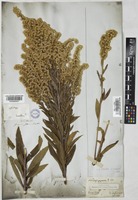
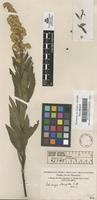
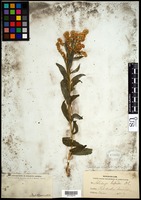
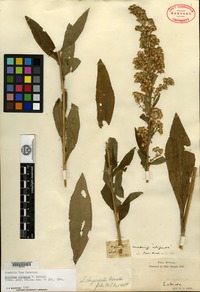
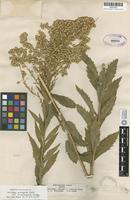
Solidago elongata

13 Images see all

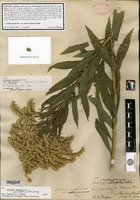
Type of Solidago serotina Aiton var. salebrosa Piper [family ASTERACEAE]
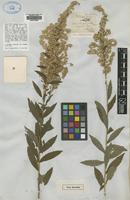
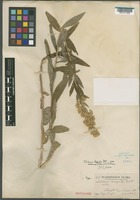
Holotype of Solidago elongata Nutt. [family ASTERACEAE]
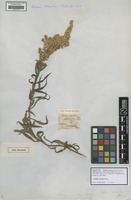
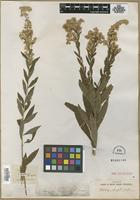
Original material of Solidago elongata Nutt. [family COMPOSITAE]
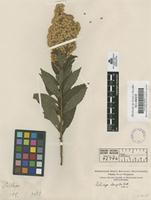
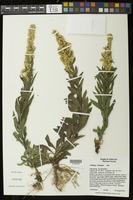
Solidago elongata Nutt. [family ASTERACEAE]
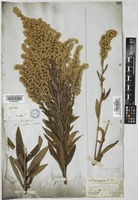
Type? of Solidago elongata Nuttall [family ASTERACEAE]
Type of Solidago caurina Piper [family ASTERACEAE]
Holotype of Solidago procera Nutt. [family ASTERACEAE]
Original material of Solidago elongata Nutt. [family COMPOSITAE]
Solidago elongata A.Gray [family COMPOSITAE]
Filed as Solidago elongata Nutt. [family ASTERACEAE]
Solidago elongata Nutt. [family ASTERACEAE]
Solidago elongata Nutt. [family COMPOSITAE]
Holotype of Solidago elongata Nutt. var. microcephala Kellogg [family ASTERACEAE]
Previous
Next

Name

Identification
Solidago elongata Nutt. [family ASTERACEAE ] (stored under name);
Related name
  • Solidago not on sheet
  • Solidago elongata
Common name
  • West Coast or Cascade Canada goldenrod, Flora of North America Vol. 20

Flora

Entry for Solidago elongata Nuttall [family COMPOSITAE]
Herbarium
Flora of North America (FNA)
Collection
Flora of North America
Resource Type
Reference Sources
Entry From
Flora of North America, Vol 20,
Names
Solidago elongata Nuttall [family COMPOSITAE], Trans. Amer. Philos. Soc., n. s., 7: 327. 1841
Solidago canadensis Linnaeus subsp. elongata (Nuttall) D. D. Keck [family COMPOSITAE]
Solidago caurina Piper [family COMPOSITAE]
Solidago elongata var. microcephala Kellogg [family COMPOSITAE]
Solidago lepida de Candolle var. caurina (Piper) M. Peck [family COMPOSITAE]
Solidago lepida var. elongata (Nuttall) Fernald [family COMPOSITAE]
Treatment Author(s)
John C. Semple
Rachel E. Cook
Information
Plants 25–150 cm; rhizomes short to long creeping, forming few- to many-stemmed clones. Stems 1–20+, erect, proximally sparsely to moderately strigoso-villous, distally usually moderately to densely so. Leaves: basal 0; proximal cauline sessile, blades narrowly to broadly oblanceolate, 35–75(–100) × (6–)7.5–14(–20) mm, proximal much smaller, tapering to bases, margins subentire or finely serrulate to coarsely, sharply serrate (teeth 0–9 per side), ciliate, 3-nerved, sometimes obscurely so, apices acute, abaxial faces glabrate to sparsely short-strigose, adaxial glabrous; mid to distal cauline sessile, blades oblanceolate, becoming lanceolate distally, 20–60 × 4–8(–11) mm, largest near mid stem, somewhat to much reduced distally, margins entire or finely serrulate, rarely serrate (teeth 1–8 per side), usually becoming entire to sparsely serrulate distally, ciliate, apices acute, faces glabrous or sparsely strigoso-villous, more so along abaxial nerves. Heads 12–500+, sometimes secund, in short to long, thyrsiform or narrowly secund-pyramidal paniculiform arrays, usually congested, club-shaped to rarely wand-shaped, (2.5–) 10–20 × (2–)4–8(–10) cm, branches usually ascending or sometimes arching spreading. Peduncles 2–7 mm, sparsely to moderately short strigoso-villous; bracteoles 1–3, linear, rarely minutely stipitate-glandular. Involucres narrowly campanulate, 2.5–3.5(–4) mm. Phyllaries in 3–4 series, strongly unequal, margins sparsely long ciliate, acute, faces glabrous, rarely sparsely minutely stipitate-glandular; outer lanceolate, inner linear-lanceolate. Ray florets (8–)11–15(–17); laminae 1–2.5 × 0.1–0.4(–0.7) mm. Disc florets (3–)5–11(–16); corollas 2.6–3.7(–4) mm, lobes 0.5–1.2 mm. Cypselae (narrowly obconic) 1–1.5 mm, sparsely to moderately strigose; pappi 2.5–3.3 mm. 2n = 18, 36.
Phenology
aug (summer), sep-oct (fall)
Altitude range
0–2800 m;
Distribution
Mexico (Baja California).USA Calif.USA Oreg.USA Wash.
Discussion
In California, coastal plants of Solidago elongata often have thicker leaves; those of the Sierras are often membranous and obscurely triple-nerved. This species can be similar to S. lepida, which usually has much larger distal cauline leaves.

Related Materials

  • Terms and Conditions
  • Privacy Policy
  • Cookie Policy
  • Cookie Settings
  • Accessibility
  • Help
  • Contact Us
  • Facebook
  • Twitter
ITHAKA

JSTOR is part of ITHAKA, a not-for-profit organization helping the academic community use digital technologies to preserve the scholarly record and to advance research and teaching in sustainable ways.

©2000-2026 ITHAKA. All Rights Reserved. JSTOR®, the JSTOR logo, JPASS®, Aluka®, and ITHAKA® are registered trademarks of ITHAKA.

╳