JSTOR Global Plants Home
  • Home
  • Browse
  • About
  • Access
  • Account
    • Saved Items
    • Profile
  • Log in

Global Plants

Skip to Main Content
  • JSTOR Global Plants Home
  • Global Plants

    • Browse
    • About
    • Access
    • Account
      • Saved Items
      • Profile
Log in
  • Browse
  • About
  • Access
  • Account
    • Saved Items
    • Profile
Advanced Search

Compilation
Sisymbrium dissitiflorum

3 Images see all

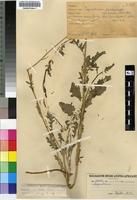
Syntype of Sisymbrium dissitiflorum O.E.Schulz [family BRASSICACEAE]
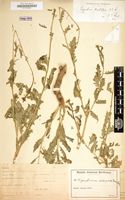
Type of Sisymbrium dissitiflorum O.E.Schulz [family CRUCIFERAE]
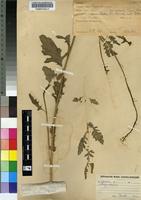
Syntype of Sisymbrium dissitiflorum O.E.Schulz [family BRASSICACEAE]
Previous
Next

Name

Identification
Sisymbrium dissitiflorum O.E.Schulz [family CRUCIFERAE ] (stored under name); Verified by Not on sheet.,
Related name
  • Sisymbrium dissitiflorum

Flora

Entry for Sisymbrium dissitiflorum [family BRASSICACEAE]
Herbarium
South African National Biodiversity Institute, Compton Herbarium, Cape Town (SAM)
Collection
Flora of Southern Africa
Resource Type
Reference Sources
Entry From
Flora of South Africa, (2003) Author: Dr J.P. Roux
Names
Sisymbrium dissitiflorum [family BRASSICACEAE]
Information
Plants glaucescent, glabrous. Rhizomes thick, woody, with several stems 30-50 cm high. Leaves slightly ciliate; lower stem leaves oblong-obovate, obtuse, pinnatifid at the base and narrowed into a short petiole; upper leaves shortly petiolate, runcinate-pinnatifid, acute, with unequal, narrowly triangular, acute, entire or dentate lobes. Raceme lax, the buds overtopping the open flowers. Pedicels 4-6 mm long, wide-spreading. Sepals 3-4 mm long, yellowish. Petals yellow, 5 mm long, broadly oblong with a broad hyaline claw. Ovary 56-ovulate. Siliquae 3-5-4 cm long, on pedicels 7-9 mm long. Otherwise like S. capense. The description is derived largely from O. E. Schulz, 1.c.
Habitat
The above specimen agrees well with the de­scription. It is from the same locality as two of those cited by Schulz and is completely glabrous and glaucous, with only a few young buds; the upper stem leaves are shortly petiolate, oblong-lanceolate to lanceolate, the lobes small, narrowly triangular, entire or dentate. Herre in STE 19059 from Besonder-meid, Steinkopf, another imperfect specimen, probably belongs here too. More material is req jired before the position of the species can be evaluated.
Use
3. Sisymbrium dissitiflorum O. E. Schulz in Pflanzenr. IV, 105 : 79 (1924); Schreiber in F.S.W.A. 48 : 11 (1966). Syntypes : South West Africa, Schultze 468; 501; Dinter 2101.

Related Materials

  • Terms and Conditions
  • Privacy Policy
  • Cookie Policy
  • Cookie Settings
  • Accessibility
  • Help
  • Contact Us
  • Facebook
  • Twitter
ITHAKA

JSTOR is part of ITHAKA, a not-for-profit organization helping the academic community use digital technologies to preserve the scholarly record and to advance research and teaching in sustainable ways.

©2000-2026 ITHAKA. All Rights Reserved. JSTOR®, the JSTOR logo, JPASS®, Aluka®, and ITHAKA® are registered trademarks of ITHAKA.

╳