JSTOR Global Plants Home
  • Home
  • Browse
  • About
  • Access
  • Account
    • Saved Items
    • Profile
  • Log in

Global Plants

Skip to Main Content
  • JSTOR Global Plants Home
  • Global Plants

    • Browse
    • About
    • Access
    • Account
      • Saved Items
      • Profile
Log in
  • Browse
  • About
  • Access
  • Account
    • Saved Items
    • Profile
Advanced Search

Compilation
Siphonochilus natalensis

4 Images see all

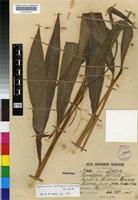
Holotype of Siphonochilus natalensis (Schltr. & K.Schum.) J.M.Wood & Franks [family ZINGIBERACEAE]
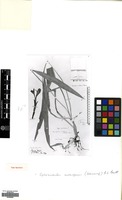
Type of Kaempferia natalensis Schltr. & K.Schum. [family ZINGIBERACEAE]
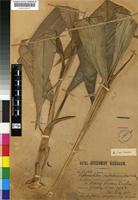
Type? of Siphonochilus natalensis (Schltr. & K.Schum.) J.M.Wood & Franks [family ZINGIBERACEAE]
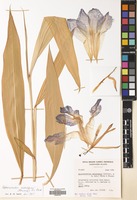
Filed as Siphonochilus aethiopicus (Schweinf.) B.L.Burtt [family ZINGIBERACEAE]
Previous
Next

Name

Identification
Siphonochilus natalensis (Schltr. & K.Schum.) J.M.Wood & Franks [family ZINGIBERACEAE ] Verified by Not on sheet, Siphonochilus aethiopicus (Schweinf.) B.L.Burtt [family ZINGIBERACEAE ] (stored under name); Verified by R.M. Smith, 1985
Related name
  • Siphonochilus aethiopicus
  • Siphonochilus natalensis

Flora

Entry for KÆMPFERIA natalensis Schlechter & K. Schum. [family ]
Herbarium
Royal Botanic Gardens, Kew (K)
Collection
Flora Capensis
Resource Type
Reference Sources
Entry From
Flora Capensis, Vol 5, Part 3, page 3, (1913) Author: (By C. H. WRIGHT.)
Names
KÆMPFERIA natalensis Schlechter & K. Schum. [family ], in Engl. Pflanzenr. Zingib. 72, fig. 10, E–F
Siphonochilus natalensis Wood & Franks [family ZINGIBERACEAE], in Kew Bulletin, 1911, 274, and in Wood, Natal Plants, vi. tt. 560–561.
Information
a perennial herb up to 2 ft. high; rhizome 8 lin. in diam. when dried; leaves nearly all radical, linear-lanceolate or linear, long-acuminate, tapering towards the base, up to 1 ft. long, nearly 1 in. wide, glabrous on both surfaces; sheath 8 in. to 1 ft. long, 4 lin. wide; ligule about 2 lin. long, membranous, rotundate or 2-lobed; scape arising outside the tuft of leaves; bracts, pedicels and ovary subterranean; flowers solitary or 3–6 racemosely arranged, hermaphrodite and female; hermaphrodite flower: calyx tubular, white, membranous, about 1 in. long, obtusely 3-toothed, split on one side about a third of the way down; corolla-tube 1 in. long; lobes 2 1/2 in. long, 7 lin. wide, lanceolate, acuminate, membranous, white; lateral staminodes erect, 3 in. long, 1 1/4 in. wide, obovate, pink; lip 2 1/2 in. long, 2 1/2 in. wide, bifid, pink with a yellow blotch at the base, united below with the lateral staminodes into a split tube 2 1/2 in. long; anther linear, 6 lin. long; connective produced above the cells into a toothed crest about 1 in. long and 5–6 lin. wide; style filiform; stigma crateriform, 3-lobed; female flower: calyx and corolla as in the hermaphrodite flower; staminodes very variable, 4–6, united into a yellow cylindrical tube about 3 in. long; lobes pink, sometimes one oblong, obtuse, 1 1/4 in. long, 7 lin. wide, with a yellow blotch at the base, and 5 others oblanceolate, unguiculate, obtuse, 4–5 lin. wide, sometimes 2–3 oblong, obtuse, 1–1 1/4 in. wide, alternating with 2–3 oblanceolate, unguiculate, about 5 lin. wide, when 5 are present 2 are broad and 3 narrow. null
Distribution
EASTERN REGION Natal; Inanda, 1800 ft., Wood, 544! Ungoye, Wylie in Herb. Wood, 11723! and without precise locality, Gerrard, 1823!
Notes
The hermaphrodite flowers of this do not differ from those of K. Ethelæ, Wood, and further investigation in the field may result in these two species being united. The existence of female flowers was d by the late Prof. W. H. Harvey in a letter to Dr. T. Thomson, written in 1865, and now preserved at Kew; the specimens to which he refers have not been found either at Kew or Dublin. The staminodes of the female flowers are very variable, even in Wood's 11723.

Related Materials

  • Terms and Conditions
  • Privacy Policy
  • Cookie Policy
  • Cookie Settings
  • Accessibility
  • Help
  • Contact Us
  • Facebook
  • Twitter
ITHAKA

JSTOR is part of ITHAKA, a not-for-profit organization helping the academic community use digital technologies to preserve the scholarly record and to advance research and teaching in sustainable ways.

©2000-2026 ITHAKA. All Rights Reserved. JSTOR®, the JSTOR logo, JPASS®, Aluka®, and ITHAKA® are registered trademarks of ITHAKA.

╳