JSTOR Global Plants Home
  • Home
  • Browse
  • About
  • Access
  • Account
    • Saved Items
    • Profile
  • Log in

Global Plants

Skip to Main Content
  • JSTOR Global Plants Home
  • Global Plants

    • Browse
    • About
    • Access
    • Account
      • Saved Items
      • Profile
Log in
  • Browse
  • About
  • Access
  • Account
    • Saved Items
    • Profile
Advanced Search

Compilation
Simocheilus ecklonianus

3 Images see all

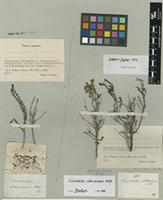
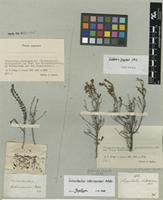
Type of Simocheilus albirameus N.E.Br. [family ERICACEAE]
Isotype of Simocheilus albirameus N.E.Br. [family ERICACEAE]
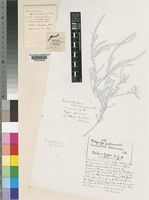
Type? of Simocheilus ecklonianus Benth. [family ERICACEAE]
Previous
Next

Name

Identification
Simocheilus albirameus N.E.Br. [family ERICACEAE ] (stored under name); Pachycalyx pubescens Klotzsch [family ERICACEAE ] Simocheilus ecklonianus Benth. [family ERICACEAE ]
Related name
  • Simocheilus ecklonianus
  • Simocheilus albirameus
  • Erica inaequalis
  • Simocheilus bicolor
  • Pachycalyx pubescens

Flora

Entry for SIMOCHEILUS bicolor Benth. [family ERICACEAE]
Herbarium
Royal Botanic Gardens, Kew (K)
Collection
Flora Capensis
Resource Type
Reference Sources
Entry From
Flora Capensis, Vol 4, page 2, (1909) Author: By H. BOLUS, F. GUTHRIE, and N. E. BROWN.
Names
SIMOCHEILUS bicolor Benth. [family ERICACEAE], in DC. Prodr. vii. 703
SIMOCHEILUS ecklonianus Benth. [family ERICACEAE], Benth. in DC. Prodr. vii. 705.
SIMOCHEILUS hispidus Benth. [family ERICACEAE], in DC. Prodr. vii. 705.
Blæria bicolor Klotzsch [family ], in Linnæa, viii. 660 (by error 606); Dietr. Synop. Pl. i. 443.
Plagiostemon bicolor Klotzsch [family ], in Linnæa, xii. 232.
Pachycalyx pubescens Klotzsch [family ], l.c. 230
Pachycalyx hispidus Klotzsch [family ], l.c. 231.
Information
probably dwarf, rigidly branched; branchlets puberulous, whitish or pale greyish; leaves 3-nate, erect or ascending, imbricate or shorter than the internodes, 2/3–1 1/2 lin. long, linear, acute or obtuse, with or without a minute simple or gland-tipped apiculus, glabrous and smooth or slightly scabrid-tuberculate on the back, or puberulous with or without an admixture of a few minute gland-tipped hairs on the back and margins; flowers sessile, 1–7 together in lateral or terminal clusters; bracts 3, unequal or subequal, 1/3– 1/2 lin. long, linear to narrowly ovate, obtuse or subacute, minutely ciliate; calyx nearly or quite 1 lin. long, subtubular or campanulate-tubular, at first of about equal diameter throughout, becoming conical-ovoid and contracted at the mouth in fruit, fleshy, rigidly so in fruit, 8-ribbed, glabrous or minutely puberulous; teeth 1/2– 3/4 as long as the tube, erect, somewhat elongated-deltoid, acute, very minutely and indistinctly ciliate with hairs or with sessile glands; corolla 1 1/2–1 3/4 lin. long, tubular, much narrowed downwards within the calyx, glabrous; lobes scarcely as long as broad, rounded, apparently incurved or connivent; anthers exserted, dorsifixed near the base, linear-oblong, dorsally spurred at the insertion of the filament; spurs awn-like, 1/6– 1/2 as long as the cells; ovary subglabrous or very minutely puberulous at the top; stigma minute, thickened or subcapitate; fruit ellipsoid, crustaceous. null
Distribution
COAST REGION Tulbagh Div.; Tulbagh Waterfall (ex Bentham), Mund & Maire! near Tulbagh, Ecklon & Zeyher! New Kloof, Burchell, 1000! Drège, 7789! near Saron, 3000 ft., Schlechter, 10682! Cape Div.; mountain near Simons Town, 800 ft., Guthrie, 1402!
Notes
The calyx appears to be red and the corolla white or pink. At Kew, the type of S. hispidus (Drège, 7789) consists of 1 glabrous and 1 puberulous-leaved specimen. The glabrous specimen I cannot distinguish from S. bicolor, whilst the puberulous specimen cannot, I think, be maintained as distinct from S. ecklonianus. I therefore consider them all to be slight forms of one species, which is evidently variable in its pubescence, for some specimens of Schlechter's 10682 are pubescent, whilst others are glabrous, and they unquestionably belong to one species. Bentham describes the anthers of S. ecklonianus and S. hispidus as spurless, whilst Klotzsch does not mention them, except in the generic character of Pachycalyx, where this character is probably taken from S. glaber, as there are no flowers with anthers on the type of S. ecklonianus or on Drège's specimen of S. hispidus at Kew, all are in the fruiting stage; in Burchell's 1000, however, which Bentham quotes under S. hispidus, the anthers are shortly but distinctly spurred.

Related Materials

  • Terms and Conditions
  • Privacy Policy
  • Cookie Policy
  • Cookie Settings
  • Accessibility
  • Help
  • Contact Us
  • Facebook
  • Twitter
ITHAKA

JSTOR is part of ITHAKA, a not-for-profit organization helping the academic community use digital technologies to preserve the scholarly record and to advance research and teaching in sustainable ways.

©2000-2026 ITHAKA. All Rights Reserved. JSTOR®, the JSTOR logo, JPASS®, Aluka®, and ITHAKA® are registered trademarks of ITHAKA.

╳