JSTOR Global Plants Home
  • Home
  • Browse
  • About
  • Access
  • Account
    • Saved Items
    • Profile
  • Log in

Global Plants

Skip to Main Content
  • JSTOR Global Plants Home
  • Global Plants

    • Browse
    • About
    • Access
    • Account
      • Saved Items
      • Profile
Log in
  • Browse
  • About
  • Access
  • Account
    • Saved Items
    • Profile
Advanced Search

Compilation
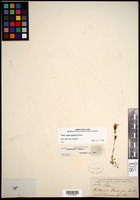
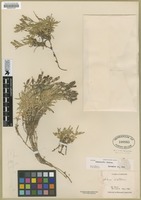
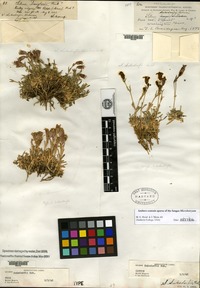
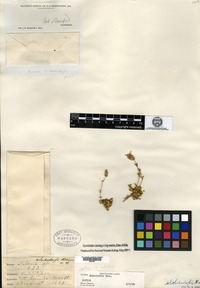
Silene suksdorfii

4 Images see all

Silene suksdorfii B.L. Rob. [family CARYOPHYLLACEAE]
Filed as Silene suksdorfii B.L. Robins. [family CARYOPHYLLACEAE]
Syntype of Silene suksdorfii B. L. Robinson [family CARYOPHYLLACEAE]
Previous
Next

Name

Identification
Silene suksdorfii B. L. Robinson [family CARYOPHYLLACEAE ] (stored under name); Verified by B. L. Rob., 1891
Related name
  • Silene suksdorfii
Common name
  • Suksdorf’s catchfly, Flora of North America Vol. 5

Flora

Entry for Silene suksdorfii B. L. Robinson [family CARYOPHYLLACEAE]
Herbarium
Flora of North America (FNA)
Collection
Flora of North America
Resource Type
Reference Sources
Entry From
Flora of North America, Vol 5,
Names
Silene suksdorfii B. L. Robinson [family CARYOPHYLLACEAE], Bot. Gaz., 16: 44, plate 6, figs. 9–11. 1891
Treatment Author(s)
John K. Morton
Information
Plants perennial, cespitose, with decumbent subterranean shoots; taproot stout; caudex branched, woody. Stems numerous, erect, simple, 3–15 cm, pubescent, viscid-glandular distally. Leaves mostly basal, densely tufted; basal numerous, pseudopetiolate, blade narrowly oblanceolate, tapering into base, 0.5–3 cm × 1.5–4 mm, ± fleshy, apex acute, puberulent; cauline in 1–3 pairs, ± sessile, reduced, blade narrowly oblanceolate to linear-lanceolate, 0.7–2 cm × 1–3 mm, apex acute, puberulent. Inflorescences: flowers terminal, solitary, or in single dichotomy, bracteate; bracts leaflike, 3–15 mm. Pedicels erect, ca. equaling calyx, viscid glandular-pubescent, hairs with purple septa. Flowers: calyx prominently 10-veined, cam-panulate, not contracted proximally around carpophore, 10–15 × 5–7 mm, papery, veins parallel, purplish, with pale commissures, with purple-septate glandular hairs (rarely septa not purple), lobes ovate, ca. 2 mm, margins broad, membranous, apex obtuse; corolla off-white or tinged with dusky purple, clawed, claw equaling calyx, broadened distally, limb 2-lobed, 3–5 mm, appendages ca. 1 mm; stamens equaling calyx; styles 3(–4), equaling calyx. Capsules equaling calyx, opening by 6 (or 8) teeth; carpophore 2.5–3.5 mm. Seeds brown, broadly winged, reniform, 1–2 mm, rugose-tessellate. 2n = 48.
Phenology
jun-aug (summer)
Altitude range
1600–3000 m;
Distribution
USA Calif.USA Oreg.USA Wash.
Discussion
Silene suksdorfii appears to be closely related to S. parryi but differs in its broadly winged seeds, smaller size, cespitose habit, and the prominent purple-septate hairs of the calyx, although the latter occasionally are present in S. parryi. It is very similar to, and in Idaho appears to intergrade with, another alpine species, S. sargentii, which has linear leaves and lacks the purple septa in the hairs and the broad wing on the seeds. It is similar also to S. hitchguirei; see discussion under that species.

Related Materials

  • Terms and Conditions
  • Privacy Policy
  • Cookie Policy
  • Cookie Settings
  • Accessibility
  • Help
  • Contact Us
  • Facebook
  • Twitter
ITHAKA

JSTOR is part of ITHAKA, a not-for-profit organization helping the academic community use digital technologies to preserve the scholarly record and to advance research and teaching in sustainable ways.

©2000-2026 ITHAKA. All Rights Reserved. JSTOR®, the JSTOR logo, JPASS®, Aluka®, and ITHAKA® are registered trademarks of ITHAKA.

╳