

Compilation
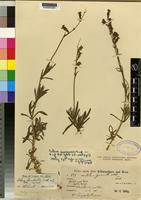
Silene meruensis
1 Images see all
Name
Identification
Silene meruensis Engl. [family CARYOPHYLLACEAE ] (stored under name); Verified by Turill W, 1953 Silene burchellii Otth ex DC. [family CARYOPHYLLACEAE ] Verified by Turill W, 1953
Related name
- Silene burchellii
- Silene meruensis
Flora
Entry for Silene burchellii [Otth ex] DC. [family CARYOPHYLLACEAE]
Herbarium
Royal Botanic Gardens, Kew (K)
Collection
Flora of Tropical East Africa
Resource Type
Reference Sources
Entry From
Flora of Tropical East Africa, page 1, (1956) Author: W. B. TURRILL
Names
Silene burchellii [Otth ex] DC. [family CARYOPHYLLACEAE], Prodr. 1: 374 (1824); Fl. Cap. 1: 128 (1860); F.T.A. 1: 138 (1868); Cat. Welw. Afr. Pl. 1: 49 (1896); Burtt Davy in K.B. 1924: 228; Exell & Mendonça in Consp. Fl. Angol. 1: 113 (1937); F.C.B. 2: 150 (1951). Type: South Africa, Cape of Good Hope, Burchell 271 (K, holo.!)
Silene pilosellaefolia Cham. & Schl. [family CARYOPHYLLACEAE], in Linnaea 1: 41 (1826). Type: South Africa, Cape Province, Knysna, Plettenbergs Bay, Mund & Maire (LE, holo.?)
Silene chirensis A. Rich. [family CARYOPHYLLACEAE], Tent. Fl. Abyss. 1: 44 (1847). Type: Ethiopia, Tigré, Shire, Quartin Dillon (P, holo.)
Silene meruensis Engl. [family CARYOPHYLLACEAE], in E.J. 48, 382 (1912). Type: Tanganyika, Mt. Meru, Uhlig 598 (B, lecto., EA, iso.-lecto.!)
Information
A perennial herb with large more or less ovoid tuberous roots (tubers said to be edible), usually covered with short hairs in all aerial parts; stems erect or ascending, often branched low down, up to 7 dm. but usually 3–4 dm. tall. Leaves very variable in size and shape, narrowly linear to oblong-lanceolate or oblong-oblanceolate, generally acute at the apex. Flowers apparently in simple, rather loose, one-sided racemes in the uppermost part of the branches with 2–7 flowers; usually a bare portion of stem between the uppermost leaves and the lowermost flowers. Calyx tubular-clavate, 1.1–2.5 cm. (very rarely up to 3.5 cm.) long (slightly elongating in fruit); teeth lanceolate to ovate, obtuse or more or less acute to shortly acuminate. Petals reddish-brown, purple, pink, mauve to white. Capsules on stalks 5–6 mm. long, not reflexed. Seeds flattened, 1.25 mm. diam., not tubercled. Fig. 13.
Range
DISTR. U1–3; K1–4, 6; T1–8
Altitude range
1500–4050 m.
Distribution
KENYA Naivasha District summit of Longonot Crater, 17 Dec. 1950, Verdcourt & Greenway 403 (narrow leaved variant)!TANGANYIKA Mbeya District Mbozi, 29 Aug. 1933, Greenway 3630 (broader leaved variant)!UGANDA Ankole District Kabira, 19 Sept. 1929, Snowden 1433!
Distribution (external)
; South Africa
Northern
Southern Rhodesia
Angola
Portuguese East Africa
Ruanda-Urundi
southern Belgian Congo
A.-E. Sudan
Ethiopia
Eritrea
Somaliland
Arabia
Notes
VARIATION. It has not been found possible satisfactorily to subdivide all the large amount of material, here included in one species, into clear cut subspecies or varieties. The type of the species is South African and plants with similar morphology (somewhat suffruticose bases, more or less prostrate or ascending stems, and oblanceolate to spathulate-elliptic leaves) are found in coastal districts of the Cape Province. There is, however, no sharp line of separation between such plants (var. burchellii) and others that have been named var. angustifolia Sond. and var. latifolia Sond. In East Africa, plants with very narrow leaves, on the whole, seem to be most frequent in the drier areas, especially of Kenya, but are by no means sharply limited in ecological distribution or geographical range. In addition to variation in leaf width, there is very considerable variation in calyx shape and length and in the length and shape of the calyx lobes. It has not, so far, been possible to obtain any very valid correlations between the variables studied in this complex species (if we so accept it). Most of the specimens seen are in flower and a wide collection of fruits and seeds might throw more light on the nature of the variability though cultural experiments are probably essential before further taxonomic research is worth while. A few somewhat extreme variants have been collected. Examples are: Uganda, Karamoja District, Mt. Moroto, 2850 m., Dale U. 455!, with calyces 2.6 to 3 cm. long; Kenya, Northern Frontier Province, Mt. Endoto, 2400 m., Jex-Blake in CM. 6911, with calyces 3.5 cm. long; Kenya, Northern Frontier Province, Marsabit, c. 1300 m., Gillett 15154!, with relatively short but broad leaves and linking the var. gillettii Turrill (from Ethiopia) to var. burchellii. With some hesitation a specimen from south-western Tanganyika has been made the type of a new variety under the name Silene burchellii var. macropetala Turrill in K.B. 1954, 57. This plant is characterized by its tall stems (up to 12 dm.), rather large leaves (3–6.5 cm. long, 0.5–2.1 cm. broad), and petals 1.5 cm. long with the blades 8–9 mm, long and the lobes of the blades 3–4 mm. long. The type, and only known, specimen came from Songea District (T8), Matengo highlands, above Ugano (presumably Ngano), Zerny 518 (W, holo.!).