JSTOR Global Plants Home
  • Home
  • Browse
  • About
  • Access
  • Account
    • Saved Items
    • Profile
  • Log in

Global Plants

Skip to Main Content
  • JSTOR Global Plants Home
  • Global Plants

    • Browse
    • About
    • Access
    • Account
      • Saved Items
      • Profile
Log in
  • Browse
  • About
  • Access
  • Account
    • Saved Items
    • Profile
Advanced Search

Compilation
Silene cucubalus

3 Images see all

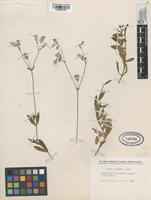
Type of Silene cucubalus Wib. var. puberula Pau [family CARYOPHYLLACEAE]
Holotype of Silene vulgaris (Moench) Garcke subsp. macrocarpa Turrill. [family CARYOPHYLLACEAE]
Filed as Silene cucubalus Wibel [family CARYOPHYLLACEAE]
Previous
Next

Name

Identification
Silene cucubalus Wibel [family CARYOPHYLLACEAE ] (stored under name); Verified by Not On Sheet,
Related name
  • Silene cucubalus
  • Silene vulgaris
Common name
  • Bladder campion, Flora of North America Vol. 5
  • silène enflé, Flora of North America Vol. 5

Flora

Entry for Silene vulgaris (Moench) Garcke [family CARYOPHYLLACEAE]
Herbarium
Flora of North America (FNA)
Collection
Flora of North America
Resource Type
Reference Sources
Entry From
Flora of North America, Vol 5,
Names
Silene vulgaris (Moench) Garcke [family CARYOPHYLLACEAE], Fl. N. Mitt.-Deutschland ed., 9, 46. 1869
Behen vulgaris Moench [family ], Methodus, 709. 1794
Silene cucubalus Wibel [family CARYOPHYLLACEAE]
Silene inflata Smith [family CARYOPHYLLACEAE]
Silene latifolia (Miller) Britten & Rendle var. pubescens (de Candolle) Farwell [family CARYOPHYLLACEAE]
Treatment Author(s)
John K. Morton
Information
Plants short-lived perennial, gla-brous, rarely pubescent, glaucous; taproot stout; caudex woody. Stems several–many, erect, branched and decumbent at base, rarely simple, 20–80 cm. Leaves mainly cauline, 2 per node, sessile, almost clasping, reduced proximal to inflorescence, blade broadly oblong to oblanceolate or lanceolate, rarely ± linear, 2–8 cm × 5–30 mm, base round, apex acute to acuminate. Inflorescences open dichasial cyme, 5–40-flowered, bracteate; bracts much-reduced, lanceolate. Pedicels 0.5–3 cm. Flowers bisexual and unisexual, some plants having bisexual flowers, others having pistillate unisexual flowers, 15–20 mm diam.; calyx pale green, rarely purplish, campanulate, not contracted at mouth or base, inflated, 9–12 mm in flower, 12–18 × 7–11 mm in fruit, herbaceous, papery, venation obscure, reticulate, without conspicuous pale commissures, margins dentate, lobes broadly triangular, 2–3 mm, glabrous; petals white, ca. 2 times as long as calyx; limb obovate, emarginate to 2-lobed; stamens exserted by 2–4 mm; styles 3, cream to greenish, at most slightly pink tinged, 2 times longer than calyx. Capsules ovoid to globose, equaling calyx, opening by 6 teeth; carpophore 2–3 mm. Seeds black or nearly so, globose-reniform, 1–1.5 mm, finely tuberculate. 2n = 24.
Phenology
jun-aug (summer), sep-nov (fall)
Altitude range
0–2000 m;
Distribution
Europe.USA AlaskaUSA Ariz.USA Ark.USA Calif.USA Colo.USA Conn.USA Del.USA D.C.USA Ga.USA IdahoUSA Ill.USA Ind.USA IowaUSA Kans.USA Ky.USA MaineUSA Md.USA Mass.USA Mich.USA Minn.USA Mo.USA Mont.USA Nebr.USA N.H.USA N.J.USA N.Y.USA N.C.USA N.Dak.USA OhioUSA Oreg.USA Pa.USA R.I.USA S.C.USA S.Dak.USA Vt.USA Va.USA Wash.USA W.Va.USA Wis.USA Wyo.Canada Alta.Canada B.C.Canada Man.Canada N.B.Canada Nfld. and Labr. (Nfld.)Canada N.S.Canada Ont.Canada P.E.I.Canada Que.Canada Sask.Canada Yukon
Discussion
Silene vulgaris is less variable in North America than in its native Europe, where five subspecies are recognized on the basis of capsule size, petal color, leaf shape, and habit. All North American material appears to belong to subsp. vulgaris, although a few collections from sandy habitats tend to have unusually narrow leaves. Similar plants from Europe have been named var. litoralis (Ruprecht) Jalas and subsp. angustifolia Hayek.
Native/Introduced
introduced;

Related Materials

  • Terms and Conditions
  • Privacy Policy
  • Cookie Policy
  • Cookie Settings
  • Accessibility
  • Help
  • Contact Us
  • Facebook
  • Twitter
ITHAKA

JSTOR is part of ITHAKA, a not-for-profit organization helping the academic community use digital technologies to preserve the scholarly record and to advance research and teaching in sustainable ways.

©2000-2026 ITHAKA. All Rights Reserved. JSTOR®, the JSTOR logo, JPASS®, Aluka®, and ITHAKA® are registered trademarks of ITHAKA.

╳