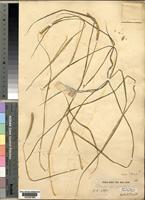
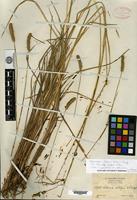
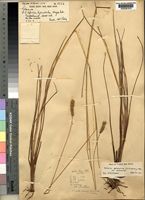
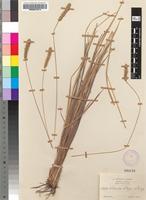
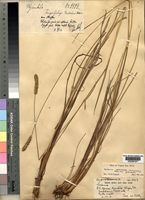
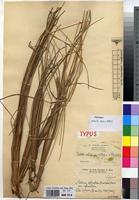
Perennial, compactly tufted on a short oblique rhizome, 2–2 1/2 ft. high; innovations intravaginal. Culms slender, erect, simple, 3–4-noded, softly and minutely tomentellous below the inflorescence, otherwise glabrous and smooth; lower internodes terete or subterete, exceeded by or only very shortly exserted from the sheath, uppermost up to 1 1/2 ft. long and long-exserted. Leaf-sheaths somewhat heteromorphous, the basal about 9 with each culm, obliquely erect, firm, brown, finely pubescent or villosulous except towards the glabrescent base, there rounded on the back, more or less compressed upwards, very finely striate, those of the culm firmly herbaceous, terete, glabrous or very sparingly pubescent upwards, all imperceptibly passing into the blades; ligule a densely ciliolate transverse rim; blade linear, tapering to a callous blunt point, continuing the sheath in a straight line, 6–10 in. long by 1 1/2–2 lin. wide (when flattened), folded, then open or mostly involute, stiff, greyish-green or that of the basal leaves brown like the sheaths, softly pubescent all over, margins smooth, midrib very slender, primary lateral nerves about 3 on each side, very fine. Inflorescence a rather stiff dense cylindric short-bristled false spike, up to 1 1/2 in. long by 3–3 1/2 lin. wide (exclusive of the bristles); rhachis slender, terete, subangular, minutely tomentellous; branches reduced to sessile involucres each supporting a solitary spikelet; bristles about 4–6 to each involucre, fine, rather rigid, scaberulous, fulvous, unequal, up to 2 1/2 lin. long; pedicels reduced to minute stumps with subdiscoid tips. Spikelets broadly oblong, subapiculate in back view, obliquely oblong to ovate-oblong and obtuse in profile, 1–1 1/4 lin. long by 1/2– 5/8 lin. wide, pale bluish to greyish-green upwards. Glumes membranous, obtuse, whitish with green nerves; lower broadly ovate, up to half the length of the spikelet, 3-nerved; upper broadly elliptic, 5- to sub-7-nerved, up to over two-thirds the length of the spikelet, loosely appressed. Lower floret ♂, as long as the upper: valve membranous, corresponding in shape and size to the spikelet as seen in front view, minutely and obtusely apiculate, slightly depressed, 5-nerved; valvule as long as the valve, broadly elliptic, subacute, keels marginate; anthers up to 1 lin. long. Upper floret hermaphrodite: valve very convex, acute to subacute or subapiculate, very finely or obscurely rugose; valvule punctate.