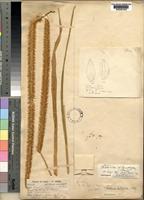
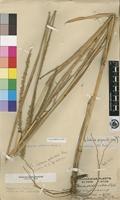
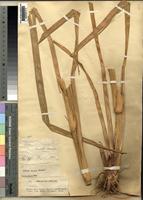
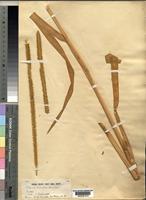
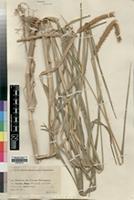
Perennial, up to over 12 ft. high, with a stout fibrous rhizome. Culms erect, robust, simple or branched below, 6–9-noded, lower internodes more or less compressed, up to 6 lin. (at the nodes to 8 lin.) wide, 3–7 lin. long, intermediate up to over 1 ft. long, quite terete, uppermost (peduncle) 1–3 ft. long and up to over 2 lin. wide at the base, quite glabrous and smooth except for some pubescence or loosely villous indumentum close to the inflorescence, strongly striate. Leaf-sheaths moderately firm, quite glabrous and smooth, the lowest laterally compressed and acutely keeled, but not flabellate, the basal 9 in. long, subpersistent, the intermediate terete, 9–10 in. long; ligule a firm scarious rim, over 1/2 lin. long, minutely ciliolate; blade linear from an equally wide or slightly constricted base, long-tapering upwards, up to over 2 1/2 ft. long, by 6–9 lin. wide, flat, quite glabrous (very rarely in the uppermost leaves softly and loosely hairy) and smooth except for the rough margins and tip, green or slightly glaucous, sometimes somewhat succulent, midrib very slender, in the largest leaves more or less keeled below, primary lateral nerves up to 5–7 on each side, fine. Inflorescence a dense continuous erect cylindric false spike, up to over 1 ft. long by 3 1/2 lin. wide (exclusive of the bristles), rufously fulvous, sometimes variegated with purple; axis subterete, somewhat stout, very minutely tomentellous; branches reduced to sessile involucres, supporting clusters of 2–4 spikelets of which usually 1 or 2 are imperfect; bristles 7–15 to each cluster or spikelet, fine, rigid or more or less flexuous, scaberulous, concolorous, 2 1/2–5 lin. long; pedicels up to 1/2 lin. long or reduced to mere stumps, tips minutely discoid. Spikelets oblong and subacute or subacuminate in back or front view, up to 1 1/4 lin. long by 1/2 lin. wide, semi-oblong in profile, glabrous, pale or dull purple. Glumes thinly membranous, rather rigid; lower broadly ovate, apiculate, one-third (or slightly more) the length of the spikelet, 3-nerved; upper similar but slightly longer (to half the length of the upper floret) and usually 5- (rarely 3-) nerved. Lower floret ♂: valve of the length and outline of the spikelet, usually at length depressed or grooved along the middle with rounded sides, 5-nerved; valvule shorter than the valve, broadly oblong, subacute; anthers 1/2 lin. long. Upper floret hermaphrodite, as long as the spikelet and corresponding to it in shape as seen from the back: valve very delicately or obscurely transversely rugose, pale or purplish upwards.