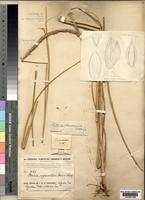
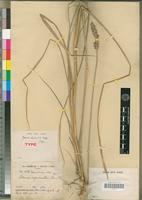
Perennial more than 3 ft. high, from an oblique, comparatively slender rhizome covered by the shreds of the disintegrating cataphylls; innovations intravaginal; cataphylls firm, very smooth and glabrous except at the insertion on the rhizome. Culms erect, stout, simple, about 6-noded, smooth and glabrous except for a narrow silvery pubescent ring at the insertion of the sheaths and the top of the peduncle which is slightly rough upwards and hairy close to the inflorescence, subglaucous, lower internodes 3–4 in. long, the following very gradually increasing, the uppermost (peduncle) 8 in. long. Leaf-sheaths tight, firm, smooth, glabrous, closely striate, the lowest slightly longer than or equal to the internodes, the following shorter; ligule reduced to a fine ciliolate rim; blade linear from an equally wide base, very long-tapering to a slender point, more or less convolute, up to over 1 ft. long by 3 lin. wide (when flattened out), rigid, subglaucous, glabrous except for some hairs near the ligule, rough along the margins, midrib deeply hollowed out downwards, prominent and rounded on the back, up to 1/2 lin. wide, primary lateral nerves 3–4 on each side, differentiated only below. Inflorescence a dense false spike about 6 in. long, 4 lin. wide (exclusive of the bristles), with the clusters of spikelets slightly prominent and in crowded oblique false whorls; axis more or less angular, softly and shortly hairy; branches slender, puberulous, up to 1 1/2 lin. long, forming clusters of up to 4 spikelets, of which, as a rule, the terminal only is perfect, the others being more or less arrested or the lowest quite rudimentary or even suppressed and only indicated by the bundle of bristles; bristles rigid, up to 4 with each spikelet, 3–4 lin. long, scaberulous all along, pale with dark purple tips; pedicels reduced to stout stumps with subdiscoid tips. Spikelets (perfect) ovate-oblong to elliptic-oblong and acute or acutely acuminate in back view, up to over 1 1/2 lin. long by 3/4 lin. wide (back and side views), very smooth, glabrous, pale below, lilac or purplish towards the tips. Glumes firmly membranous; lower ovate, acute, up to half the length of the spikelet, 7-nerved; upper subacute, four-fifths the length of the spikelet, 9-nerved. Lower floret ♂: valve similar to the upper glume but as long as the spikelet and 7-nerved; valvule oblong, obtuse, almost as long as the valve, keels marginate; anthers 2/3 lin. long. Upper floret hermaphrodite: valve ovate-oblong, acutely apiculate, as long as the lower or almost so, pale with a dark tip, delicately punctate or very faintly rugose when seen through a lens.