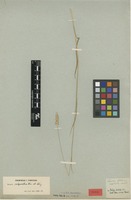
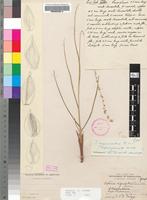
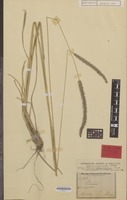
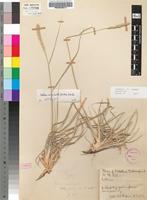
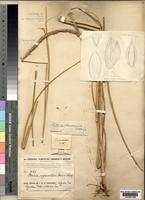
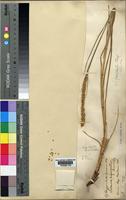
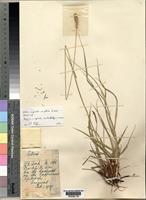
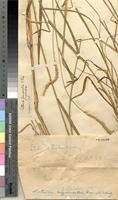
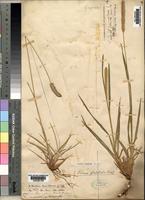
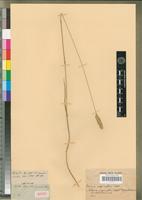
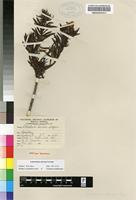
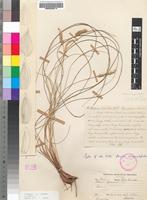
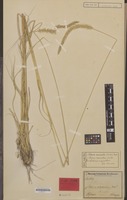
perennial; rhizome short, oblique, præmorse; culms erect or subgeniculate, slender, 1/2 to more than 2 ft. long, compressed, pubescent and scabrid just below the panicle and usually more or less tomentose below the nodes, otherwise glabrous and smooth, 1–3-noded, internodes usually enclosed except the uppermost; sheaths tight, firm, strongly striate, glabrous except on the ciliate margins and tomentose nodes, or sparingly hairy, lowest short and fugaciously hairy like the innovation bud-scales, very firm, persistent, dark brown; ligules very short, ciliate; blades linear to linear-lanceolate, often with a gradually narrowed base, tapering to an acute point, 4–9 in. (rarely more) by 3–4 lin., rather firm, flat or involute, glabrous, smooth or margins scaberulous; panicle spike-like, cylindric, stout, rather dense, sometimes interrupted, 1–5 in. by 3–5 lin.; axis angular, finely villous; branches reduced to subsessile clusters of 2–3 spikelets or to a single spikelet, each subtended by a fascicle of 3–4 or, if solitary, by as many as 8 coarse subflexuous scaberulous bristles 2 1/2–4 1/2 lin. long with slightly thickened almost smooth and blackish tips; pedicels stout, very short, tips discoid; spikelets turgid, obliquely ovoid, 1 3/4–2 1/4 lin. long, pale with dark tips, glabrous; glumes firmly membranous, lower broadly ovate, acute, about 1/2 as long as the spikelet or slightly longer, 5-nerved, upper oblong, very concave, subapiculate, almost as long as the spikelet or shorter by 1/4– 1/5, 7-nerved; lower floret ♂; valve equalling the upper floret, oblong, subapiculate, 5-nerved; pale equalling the valve; hermaphrodite floret elliptic-oblong, slightly beaked; valve 5-nerved, very convex, finely honey-combed, yellowish, beak purple or blackish; anthers 1–1 1/4 lin. long. null