JSTOR Global Plants Home
  • Home
  • Browse
  • About
  • Access
  • Account
    • Saved Items
    • Profile
  • Log in

Global Plants

Skip to Main Content
  • JSTOR Global Plants Home
  • Global Plants

    • Browse
    • About
    • Access
    • Account
      • Saved Items
      • Profile
Log in
  • Browse
  • About
  • Access
  • Account
    • Saved Items
    • Profile
Advanced Search

Compilation
Setaria modesta

2 Images see all

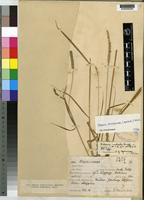
Isotype of Setaria modesta [family GRAMINEAE]
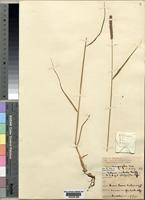
Holotype of Setaria modesta Stapf [family POACEAE]
Previous
Next

Name

Identification
Setaria incrassata (Hochst.) Hack. [family GRAMINEAE ] (stored under name); Verified by Not on sheet, Isotype of Setaria modesta [family GRAMINEAE ]
Related name
  • Setaria incrassata
  • Setaria modesta

Flora

Entry for SETARIA modesta Stapf [family POACEAE]
Herbarium
Royal Botanic Gardens, Kew (K)
Collection
Flora of Tropical Africa
Resource Type
Reference Sources
Entry From
Flora of Tropical Africa, Vol 9, page 1, (1917) Author: (By O. STAPF.)
Names
SETARIA modesta Stapf [family POACEAE]
Information
Perennial, 2–2 1/2 ft. high, from a short rhizome. Culms moderately stout to slender, simple, with a delicate silky down at the insertion of the sheaths, otherwise quite glabrous, uppermost internode (peduncle) up to 10 in. long, finely striate, slightly scabrid towards the inflorescence. Leaf-sheaths tight, firm, with densely ciliate margins, keelless, striate, smooth and glabrous, the lowermost appressed-tomentose at the base; ligule a shortly ciliate rim; blade linear from a hardly narrowed base, long-tapering to a slender point, flat, flexuous, 6 in. long by 2 1/2–3 lin. wide, somewhat glaucous, very finely hairy (with tubercle-based hairs) on both sides, somewhat rough on the margins upwards, midrib not more prominent than the slender primary lateral nerves which are up to 3/8 lin. distant at the middle. Inflorescence a continuous, or slightly interrupted, dense, false spike, 2–4 in. long by 2–3 lin. wide (exclusive of the bristles); axis slightly angular, finely puberulous; branches up to 1 1/4 lin. long, very slender, very finely puberulous, forming clusters of up to 6 mostly perfect spikelets; bristles slender, about 1 with each spikelet, very unequal, often shorter than the spikelets, the longest 2 1/2 lin. long, pale to dark purplish; pedicels up to 1/4 lin. long, with minutely discoid tips. Spikelets ovate-elliptic and apiculate in back view, slightly over 1 lin. to 1 1/4 lin. long and up to 3/4 lin. wide in profile, very smooth, glabrous, pale purplish or livid. Glumes thinly membranous; lower rotundate-ovate, subacute, 5–7-nerved, half the length of the spikelet; upper broadly elliptic, acute, 7-nerved, one-sixth shorter than the spikelet. Lower floret ♂: valve similar to the upper glume, but narrower and as long as the spikelet, 5-nerved; valvule elliptic-oblong, slightly shorter than the valve. Upper floret hermaphrodite: valve elliptic-oblong, acuminate in back view, 1 lin. long, very convex on the back, semi-ovate and beaked in profile, almost 1/2 lin. across, finely transversely rugose; valvule rather narrow as seen between the involute margins of the valve.
Distribution
Tanganyika Mozamb. Dist. Masai Reserve, Loitiss, 4000 ft., common in open bush-steppe, Manleitner, 5357!
Notes
In some respects very similar to S. mombassana, suggesting a weakened or young state of that species, but the spikelets are much smaller than those of S. mombassana at the same stage of development, the bristles much shorter, the clusters less compact with the pedicels distinctly longer, whilst the indumentum of the inflorescence is also much shorter. A specimen collected by Haarer (No. 1287) at Ngulu in the Pare District of Tanganyika Territory, may prove to be this species, it has very similar spikelets but the bristles are up to 5 lin. long.

Related Materials

  • Terms and Conditions
  • Privacy Policy
  • Cookie Policy
  • Cookie Settings
  • Accessibility
  • Help
  • Contact Us
  • Facebook
  • Twitter
ITHAKA

JSTOR is part of ITHAKA, a not-for-profit organization helping the academic community use digital technologies to preserve the scholarly record and to advance research and teaching in sustainable ways.

©2000-2026 ITHAKA. All Rights Reserved. JSTOR®, the JSTOR logo, JPASS®, Aluka®, and ITHAKA® are registered trademarks of ITHAKA.

╳