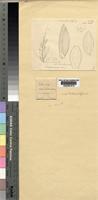
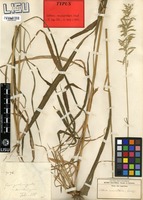
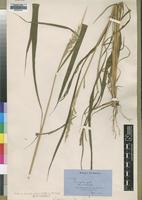
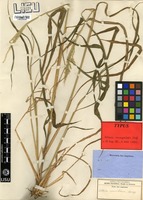
A perennial, up to 2 ft. high, from a very short prostrate base. Culms rather slender, compressible, not much over 1/2 lin. thick, 5–6-noded, terete, sparingly branched below with the branches erect, glabrous and smooth, sheathed all along, but the lower internodes partly bared by the slipping off of the sheaths. Leaf-sheaths moderately firm, terete, keeled upwards, appressedly silkily hairy at the nodes, otherwise glabrous and smooth; ligule reduced to a densely ciliate rim; blade linear-lanceolate to sublinear from a mostly long-attenuated or almost petioled base, tapering to a fine or setaceous point, up to over 1 ft. long by up to 5–7 lin. wide, pleated and crinkled when young, then flattened out, very sparingly and minutely hairy to glabrous, rough, midrib slender except at the petioloid laterally compressed base, primary lateral nerves 5–7 on each side. Inflorescence panicled, linear to linear-lanceolate, about 6 in. long by 2/3 to almost 1 in. wide; axis slender, angular, finely puberulous; branches irregularly scattered or approximate, the lower rarely more than 1/2 in. apart, obliquely erect to suberect, 2/3– 3/4 in. long, their rhachis slender, wavy, very angular, scaberulous or puberulous, terminating with a bristle, the intermediate bearing from the base solitary spikelets (very rarely the lowest accompanied by a rudimentary second spikelet), each spikelet supported by a very slender wavy scaberulous pale bristle, up to over 4 lin. long; pedicels mostly reduced to short stumps with discoid tips or here and there slightly elongated. Spikelets discontiguous, ovate-oblong to oblong, acutely apiculate, slightly over 1 lin. to almost 1 1/2 lin. long by 1/2 lin. wide, somewhat oblique in profile, pale green. Glumes membranous; lower very thin, rotundate, one-quarter the length of the spikelet, shortly and faintly 3-nerved; upper ovate-oblong, acute, as long or almost as long as the upper floret, 9-nerved with greenish nerves. Lower floret barren (with rudimentary stamens), slightly exceeding the upper: valve firmly membranous, oblong to ovate-oblong, acute, narrowly depressed between the bulging sides, 7-nerved with the inner side-nerves more or less impressed; valvule narrowly elliptic-oblong, nearly as long as the valve, keels marginate. Upper floret hermaphrodite, elliptic-oblong and shortly acute in back view, narrowly oblong in profile: valve and valvule subcoriaceous, finely transversely wrinkled.