

Compilation
Setaria laxispica
1 Images see all
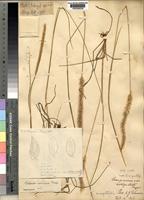
Name
Identification
Setaria laxispica Stapf [family POACEAE ] Verified by Stapf, O., Setaria sphacelata (Schumach.) Stapf & C.E.Hubb. ex M.B.Moss [family POACEAE ] (stored under name); Setaria aurea A.Br. [family POACEAE ] Setaria angustifolia Stapf [family POACEAE ]
Related name
- Setaria aurea
- Setaria angustifolia
- Setaria laxispica
- Setaria sphacelata
Flora
Entry for SETARIA laxispica Stapf [family POACEAE]
Herbarium
Royal Botanic Gardens, Kew (K)
Collection
Flora of Tropical Africa
Resource Type
Reference Sources
Entry From
Flora of Tropical Africa, Vol 9, page 1, (1917) Author: (By O. STAPF.)
Names
SETARIA laxispica Stapf [family POACEAE]
Information
Perennial, up to 2 ft. high, densely tufted on a short rhizome; innovations intravaginal. Culms very slender, erect, simple, 2-noded, glabrous, subscaberulous close to the inflorescence, otherwise smooth; lowest internode about 1 in. long, long exceeded by the basal sheaths, terete or subterete, the intermediate 3–5 in., the uppermost (peduncle) up to 1 1/2 ft. long and very long-exserted. Leaf-sheaths quite glabrous and smooth, the basal somewhat firm downwards, closely striate, persistent, at length breaking up into fibres, 1–2 1/2 in. long, terete, not keeled, the following herbaceous, rather tight or the intermediate sometimes slipping off the culm, flattening out upwards and then very like the blade; ligule a transverse ciliolate rim; blade narrowly linear from an equally broad base passing very gradually into the sheath, long-tapering to a setaceous point, from a few to 6 in. long by 1 lin. wide, convolute in vernation, mostly imperfectly opening out, green or slightly glaucous, smooth and glabrous except for some long fine spreading hairs towards the ligule, midrib and primary nerves (2–3 on each side) very slender. Inflorescence a slender slightly flexuous loose but continuous cylindric false spike, 3 1/2–5 in. long by 2 1/2 lin. wide (exclusive of the bristles), pale fulvous; axis slender, subterete, hardly sulcate, minutely tomentellous; branches reduced to sessile involucres each supporting a solitary spikelet; bristles capillary, about 10–12 to each involucre, more or less unequal, 4–6 lin. long, whitish downwards, otherwise fulvous; pedicels reduced to small stumps with subdiscoid tips. Spikelets oblong to elliptic-oblong in back view, semi-elliptic-ovate in profile, acute or apiculate, about 1 1/4 lin. long by 1/2 lin. wide, glabrous, pale greenish. Glumes thinly membranous, acute or subacute, whitish; the lower broadly ovate, 3-nerved, one-third to almost half the length of the spikelet; upper elliptic-oblong, about three-quarters the length of the spikelet, 5-nerved. Lower floret ♂: valve as long as the fertile floret or very slightly longer, corresponding in size and outline to the spikelet in front view, somewhat flattened and depressed along the median line, 5-nerved; valvule as long as the valve, elliptic, subacute, narrowly marginate; anthers 3/4 lin. long. Upper floret hermaphrodite, corresponding in outline to the spikelet as seen from the back: valve whitish, greenish or greyish to dark grey upwards, like the valvule delicately rugose.
Distribution
Nigeria Upper Guinea Lokoja District; Patti, 1400 ft., Richardson !