JSTOR Global Plants Home
  • Home
  • Browse
  • About
  • Access
  • Account
    • Saved Items
    • Profile
  • Log in

Global Plants

Skip to Main Content
  • JSTOR Global Plants Home
  • Global Plants

    • Browse
    • About
    • Access
    • Account
      • Saved Items
      • Profile
Log in
  • Browse
  • About
  • Access
  • Account
    • Saved Items
    • Profile
Advanced Search

Compilation
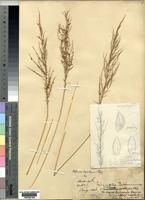
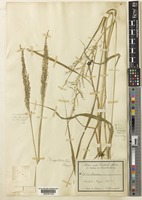
Setaria lasiothyrsa

2 Images see all

Holotype of Setaria lasiothyrsa Stapf [family POACEAE]
Previous
Next

Name

Identification
Setaria longiseta P.Beauv. [family POACEAE ] (stored under name); Setaria lasiothyrsa Stapf [family POACEAE ] Panicum longipetiolatum Pilger [family POACEAE ]
Related name
  • Setaria longiseta
  • Panicum longipetiolatum
  • Setaria lasiothyrsa

Flora

Entry for SETARIA longiseta P. Beauv. [family POACEAE]
Herbarium
Royal Botanic Gardens, Kew (K)
Collection
Flora of Tropical East Africa
Resource Type
Reference Sources
Entry From
Flora of Tropical East Africa, page 451, (1982) Author: W. D. CLAYTON and S.A. RENVOIZE
Names
SETARIA longiseta P. Beauv. [family POACEAE], Fl. Owar. 2: 81, fig. 110/2 (1819); F.T.A. 9: 836 (1930); Fl. Agrost. Congo Belge 2: 274 (1934); Ann. list grasses Ug.: 42 (1947); F.P.N.A. 3: 115 (1955); F.P.S. 3: 536 (1956); R.K.G.: 41 (1958); Ann. list Nyasaland grasses: 58 (1958); I.G.U.: 54 (1960); G.T.: 86 (1965); Clayton in F.W.T.A., ed. 2, 3: 423 (1972). Type: Nigeria, Palisot de Beauvois (G, holo.!)
Panicum longifolium Schumach. [family POACEAE], Beskr. Guin. Pl.: 63 (1827). Type: Ghana, Thonning 401 (C, holo.!, S, iso.!)
Panicum rescissum Trin. [family POACEAE], in Mém. Acad. Sci. Pétersb., ser. 6, 3: 218 (1834). Based on Setaria longiseta P. Beauv., non Panicum longisetum Poir. (1816)
Pennisetum longisetum (P. Beauv.) K. Schum. [family POACEAE], in P.O.A. C: 105 (1895)
Setaria paniciformis Rendle [family POACEAE], Cat. Afr. Pl. Welw. 2: 186 (1899). Types: Angola, Luxillo, Welwitsch 2753 (K, isosyn.!) & without locality, Welwitsch 2764 (K, isosyn.!) & 2764b (K, isosyn.!) & 2858 (LISU, syn.)
Panicum longepetiolatum Pilg. [family POACEAE], in E.J. 33: 45 (1902), nom. confus. Type: Sudan, Maschiro Hills, Schweinfurth 4027 (B, holo.†)—this sheet includes foliage of Andropogon gayanus
Setaria lasiothyrsa Massey [family POACEAE], Sudan Grasses: 33 (1926); F.T.A. 9: 838 (1930); Fl. Agrost. Congo Belge 2: 277 (1934); F.P.N.A. 3: 115 (1955); F.P.S. 3: 536 (1958). Type: Sudan, Maschiro Hills, Schweinfurth 4027 (K, holo.!)—this sheet bears no extraneous foliage
Setaria longepetiolata (Pilg.) A. Camus [family POACEAE], in Bull. Soc. Bot. Fr. 74: 633 (1927)
Information
Loosely tufted perennial; culms 50–150 cm. high, geniculately ascending, the nodes glabrous. Leaf-blades linear, 7–40 cm. long, 1–6(–10) mm. wide, neither plicate nor petiolate, setaceously acuminate. Panicle lanceolate to ovate, 7–25 cm. long, with spikelets loosely clustered around the primary branches, often purple tinged, the rhachis scaberulous with occasional long hairs or rarely hirsute; bristles 2–12 mm. long, scaberulous below, often smooth above. Spikelets elliptic, 1.5–2.2 mm. long, slightly gibbous, generally acute; lower glume 1/4–1/3 as long as the spikelet, mostly acute; upper glume 2/3–3/4 as long as the spikelet, often acute; lower floret ♂, its lemma firmly and smoothly membranous with a pronounced median groove; upper lemma finely but distinctly rugose, pallid becoming golden.
Range
DISTR. U1–4; K3, 5, 6; T1, 4, 7, 8 tropical Africa
Altitude range
1000–2300 m.
Distribution
KENYA Trans-Nzoia District Kitale, 18 June 1948, Bogdan 1672! & 14 Oct. 1964, Leippert 5153!KENYA N. Kavirondo District Kalait, Feb. 1930, Lyne Watt 1402!TANZANIA Bukoba District Bugene, Oct. 1931, Haarer 2292!TANZANIA Ngara, 18 Dec. 1959, Tanner 4671!TANZANIA Mbeya District Ipinda–Chunya road, 6 Feb. 1959, Vesey-FitzGerald 2275!UGANDA W. Nile District Nebbi [Nibbi], 17 June 1936, A.S. Thomas 2025!UGANDA Ankole District Ruizi R., 14 Oct. 1950, Jarrett 277!UGANDA Teso District Bugwere, 12 July 1927, Snowden 1143!
Notes
Best recognized by the combination of grooved lower lemma and exposed rugose upper lemma. The acute spikelets provide a useful, but occasionally unreliable, distinction from S. orthosticha. The density of long hairs on the panicle-rhachis is very variable, and seems to be of no taxonomic significance.It can be confused with narrow-leaved forms of S. lindenbergiana; these differ in their densely caespitose base, contracted panicle, usually longer upper glume, and thinner ungrooved lower lemma.

Related Materials

  • Terms and Conditions
  • Privacy Policy
  • Cookie Policy
  • Cookie Settings
  • Accessibility
  • Help
  • Contact Us
  • Facebook
  • Twitter
ITHAKA

JSTOR is part of ITHAKA, a not-for-profit organization helping the academic community use digital technologies to preserve the scholarly record and to advance research and teaching in sustainable ways.

©2000-2026 ITHAKA. All Rights Reserved. JSTOR®, the JSTOR logo, JPASS®, Aluka®, and ITHAKA® are registered trademarks of ITHAKA.

╳