JSTOR Global Plants Home
  • Home
  • Browse
  • About
  • Access
  • Account
    • Saved Items
    • Profile
  • Log in

Global Plants

Skip to Main Content
  • JSTOR Global Plants Home
  • Global Plants

    • Browse
    • About
    • Access
    • Account
      • Saved Items
      • Profile
Log in
  • Browse
  • About
  • Access
  • Account
    • Saved Items
    • Profile
Advanced Search

Compilation
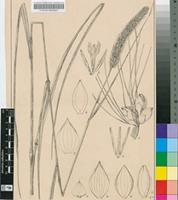
Setaria gerrardii

9 Images see all

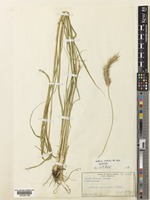
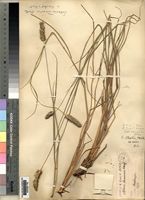
Paratype of Setaria perberbis Stapf ex de Wit [family POACEAE]
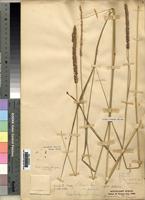
Holotype of Setaria gerrardii Stapf var. purpurea Stapf [family POACEAE]
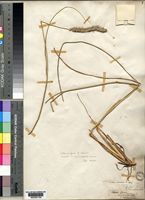
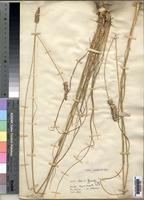
Syntype of Setaria gerrardii Stapf [family POACEAE]
Isotype of Setaria woodii Hack. [family POACEAE]
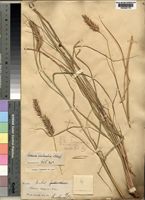
Syntype of Setaria gerrardii Stapf [family POACEAE]
Syntype of Setaria pabularis Stapf [family POACEAE]
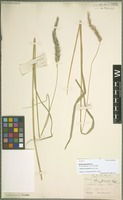
Syntype of Setaria gerrardii Stapf [family POACEAE]
Setaria gerrardii Stapf
Previous
Next

Name

Identification
Setaria gerrardii Stapf [family POACEAE ]
Related name
  • Setaria gerrardii

Flora

Entry for SETARIA Gerrardii Stapf [family POACEAE]
Herbarium
Royal Botanic Gardens, Kew (K)
Collection
Flora Capensis
Resource Type
Reference Sources
Entry From
Flora Capensis, Vol 7, page 310, (1900) Author: (By O. STAPF.)
Names
SETARIA Gerrardii Stapf [family POACEAE]
Information
perennial; rhizome short, præmorse, oblique; culms erect, 2 1/2–3 1/2 ft. long, compressed below, villous close to the panicle, otherwise smooth and glabrous, 2–4-noded, internodes usually long exserted, except the lowest; sheaths tight, striate, glabrous except on the ciliate margins and very finely silky nodes, lower compressed, keeled, pallid or purplish, firm, persistent, fugaciously hairy at the base, 2–6 in. long; ligule a very densely and long ciliate rim; blades narrow, linear, tapering to a very long, fine point, over 1 ft. by 1 1/4–2 lin. (unfolded), usually folded or involute above, flexuous, glaucous, glabrous, margins cartilaginous, scabrid; panicle spike-like, cylindric, dense 1 1/2–3 in. by 3–4 lin.; axis subvillous; branches reduced to subsessile clusters of 2–3 spikelets or to a single spikelet, each spikelet subtended by a fascicle of 3–4 or, if solitary, by 6–8 slender subflexuous bristles, 4–6 lin. long, purple from the middle, scabrid all along; pedicels very short, tips discoid; spikelets obliquely ovoid, 1 1/4–1 1/2 lin. long, whitish, glabrous; glumes firmly membranous, lower ovate, acute, about half as long as the spikelet, 5-nerved, upper oblong, very concave, subapiculate, shorter than the spikelet by 1/4, 7-nerved; lower floret ♂; valve equalling or slightly exceeding the upper floret, oblong, 5-nerved, subapiculate; pale equal to the valve; hermaphrodite floret elliptic-oblong, slightly beaked, 1 1/2 lin. long; valve very convex, 5-nerved, very finely honey-combed, pallid, sometimes with a dark spot near the tip; anthers almost 1 lin. long. null
Distribution
EASTERN REGION Basutoland; Leribe, Buchanan, 224! Natal; without precise locality, Gerrard, 681! Buchanan, 302!KALAHARI REGION Var. β: Transvaal, Limvuba River, Nelson, 42*!

Related Materials

  • Terms and Conditions
  • Privacy Policy
  • Cookie Policy
  • Cookie Settings
  • Accessibility
  • Help
  • Contact Us
  • Facebook
  • Twitter
ITHAKA

JSTOR is part of ITHAKA, a not-for-profit organization helping the academic community use digital technologies to preserve the scholarly record and to advance research and teaching in sustainable ways.

©2000-2026 ITHAKA. All Rights Reserved. JSTOR®, the JSTOR logo, JPASS®, Aluka®, and ITHAKA® are registered trademarks of ITHAKA.

╳