

Compilation
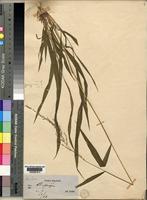
Setaria flaccifolia
1 Images see all
Name
Identification
Setaria flaccifolia Stapf [family POACEAE ] Setaria barbata (Lam.) Kunth [family POACEAE ] (stored under name); Panicum unrecorded unrecorded [family POACEAE ]
Related name
- Panicum unrecorded
- Setaria flaccifolia
- Setaria barbata
Flora
Entry for SETARIA flaccifolia Stapf [family POACEAE]
Herbarium
Royal Botanic Gardens, Kew (K)
Collection
Flora of Tropical Africa
Resource Type
Reference Sources
Entry From
Flora of Tropical Africa, Vol 9, page 1, (1917) Author: (By O. STAPF.)
Names
SETARIA flaccifolia Stapf [family POACEAE]
Information
Perennial, tufted on a short oblique rhizome, up to 2 ft. high, with intravaginal innovations. Culms stiffly erect, slender, about 4-noded, simple or nearly so, intermediate internodes up to over 4 in. long, uppermost 7 in. long, all but the lowest exserted, quite smooth and glabrous. Leaf-sheaths tight, more or less compressed and sharply keeled upwards, or the uppermost terete, subherbaceous, ciliate along the margins and often bearded at the mouth, otherwise glabrous and smooth, finely striate; ligule a densely ciliolate rim; blade linear-lanceolate to sublinear from a gradually and sometimes much narrowed base, tapering to a fine point, up to 8 in. long by 3 1/2–6 lin. wide, flat with a slightly pleated base, thin, flaccid, dark green, glabrous or sparingly ciliate at the base and here and there with a few fine stiff hairs, rough, midrib very slender, primary lateral nerves 3–4 on each side, distinct in transmitted light. Inflorescence panicled, erect, flexuous, loose and narrow, about 7 in. long by up to 1 in. wide, axis slender, terete and smooth below, subangular and rough upwards; branches suberect or slightly spreading, solitary, the lower distant by over 1 in., the following by about 1/2 in., filiform, subflexuous, angular, scabrid, terminating with a bristle, the lowest up to 2 in. long, those up to the middle gradually, the upper rapidly decreasing in length, bearing many to few shortly pedicelled or subsessile rather scattered solitary or paired spikelets in downwards compound or quite simple very slender racemes, most spikelets or pairs of spikelets supported by a solitary bristle, in compound racemes the secondary racemes up to 4-spiculate; bristles fine, capillary upwards, flexuous, up to 4 lin. long, often much shorter; pedicels very short, rough. Spikelets oblong, acute to acutely apiculate in back view, up to 1 1/2 lin. long by 1/2 lin. wide, oblique in profile, green. Glumes very unequal, thinly membranous; lower rounded, very obtuse, 5-nerved, one-third the length of the spikelet or slightly less; upper very broadly elliptic, concave, obtuse, two-thirds to three-fourths the length of the upper floret, 7–9-nerved. Lower floret ♂, somewhat exceeding the upper, dorsally depressed: valve thinly membranous, oblong, apiculate, 5-nerved; valvule lanceolate-oblong, slightly shorter than the valve; anthers up to over 1/2 lin. long. Upper floret hermaphrodite, oblong in back view, acute or apiculate or subrostrate, turning pale brown on maturity: valve and valvule crustaceous, the former finely transversely rugose with smooth tips.
Distribution
Portuguese East Africa Mozamb. Dist. Shupanga, Kirk !