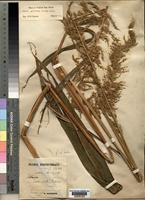
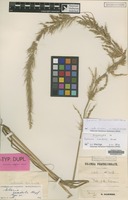
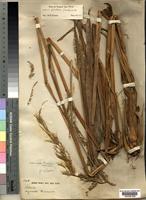
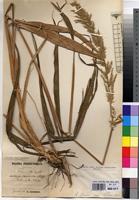
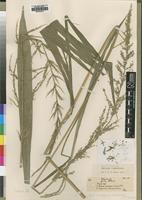
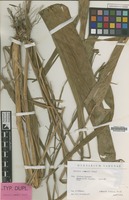
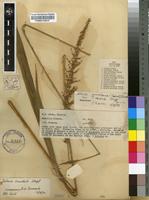
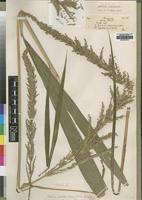
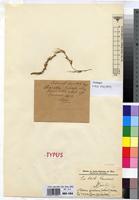
A coarse perennial, up to 10 ft. high, from a short oblique rhizome; innovations extravaginal with firm strongly striate glabrous or basally hairy cataphylls, the outer 2–3 up to over 1 in. long, the following much elongated. Culms erect or ascending, sparingly branched, stout, up to 1/2 in. thick at the base, 6- or more-noded, sheathed to very high up, the uppermost internode at length up to over 2 ft. long and more or less exserted, lower internodes compressed and, where facing a branch, deeply channelled, more or less rough below the nodes and the inflorescence and the lowest sometimes densely but fugaciously tomentose or almost bearded close to the nodes. Leaf-sheaths long, rather tight, very firm, strongly and closely striate, glabrous or sparingly hirsute with tubercle-based deciduous hairs, rigidly ciliate along the margins, the lower and intermediate more or less compressed and stoutly though not prominently keeled upwards, the upper terete; ligule reduced to a densely ciliate rim; blade very much like that of S. sulcata, up to 2 in. wide, hirsute or glabrous. Inflorescence a large contracted or downwards interrupted and open decompound panicle, up to over 2 ft. long; axis terete, very stiff, striate to sulcate, rough to pubescent all over; branches very unequal, flexuous, usually in dense false semi-whorls or fascicles owing to abundant division from the base, or solitary dividing from a short distance above the base, the lowest up to over 1/2 ft. long, irregularly distant (to 2 in.), very slender and flexuous, the upper up to over 1 1/2 in. long and closely crowded, the longest divided low down to the third and even the fourth degree, their primary branchlets often distant, up to over 2 in. long, the following divisions all short, only a few lines long, forming subsecund compound or upwards simply contracted racemes of mostly perfect spikelets, each supported by 1, or owing to abortion of a spikelet, 2 bristles; bristles fine, flexuous, scaberulous, up to 6 lin. long; pedicels very short, slender, scaberulous, with small discoid tips. Spikelets lanceolate, apiculate to caudulate-acuminate, up to over 1 1/2 lin. long by hardly 1/2 lin. wide, pale olive-brown. Glumes thinly membranous; lower broadly ovate, obtuse or subobtuse, 3-nerved, from less than half to half the length of the spikelet; upper oblong, acute, rather narrow, leaving on both sides a great part of the upper floret uncovered, about two-thirds to three-fourths the length of the same and appressed to it, 5- to sub-7-nerved. Lower floret barren, longer than the upper: valve lanceolate-oblong, produced into a short straight or more often incurved beak, 5-nerved, of the same texture as the glumes, dorsally more or less depressed; valvule lanceolate-oblong, acute, as long as the valve minus the beak. Upper floret hermaphrodite, oblong, finely acuminate, honey-coloured or brownish, glossy: valve and valvule subcoriaceous, smooth; anthers 1/2 lin. long.