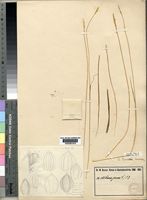
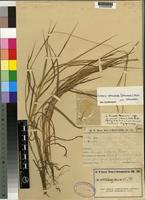
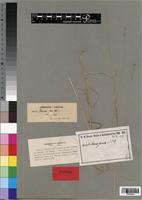
Perennial, up to over 1 ft. high. Culms very slender to filiform, erect, 3–4-noded with short leafy branches from the lower nodes, quite glabrous or minutely tomentellous close to the inflorescence, below the latter also slightly rough, uppermost internode more than half the length of the culm and long-exserted. Leaf-sheaths moderately firm, very narrow, glabrous, finely striate, finely keeled upwards; ligule a ciliolate rim; blade narrowly linear from a moderately constricted base, tapering to a setaceous point, up to over 7 in. long by 1–1 1/2 lin. wide, soft, flexuous, flat or involute, with a few long white hairs towards the base, otherwise glabrous, smooth, midrib very slender, primary lateral nerves very fine, 3–4 on each side. Inflorescence a straight slender short-bristled rather loose but continuous spike, 3/4–1 in. long by 2 lin. wide (exclusive of the bristles); rhachis very slender, finely sulcate, very minutely tomentellous; branches reduced to subsessile involucres, each supporting a solitary spikelet; bristles fine, rigid, scaberulous, up to 1 1/4 lin. long, very pale; pedicels reduced to short stumps with subdiscoid tips. Spikelets elliptic in back view, semi-obovate to semi-elliptic in profile, apiculate to almost mucronulate, 1–1 1/4 lin. long by 7/10– 6/10 lin. wide (either view). Glumes thinly membranous, whitish; lower broadly ovate to rotundate-ovate, subacute, appressed to the lower floret and up to almost half as long, 3-nerved; upper similar but loosely appressed to or upwards free from the upper floret, and three-quarters or almost the length of the same, 5-nerved. Lower floret as long as the fertile, ♂: valve membranous, dorsally flattened or depressed, narrow in profile, 5-nerved; valvule very broad, subacute, as long as the valve, finely keeled. Upper floret hermaphrodite, much curved and very convex on the back, rich chestnut-to coffee-brown: valve apiculate to mucronulate, very faintly rugose, or almost smooth; valvule almost smooth, sharply 2-keeled with minute cilia outside the keels, the cilia visible along the margin of the embracing valve.