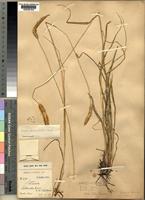
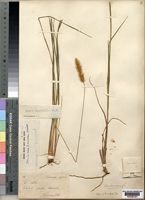
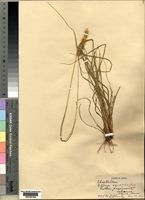
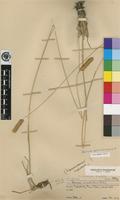
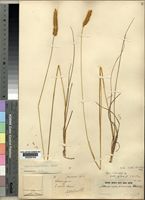
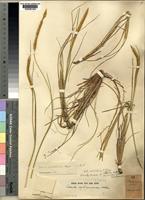
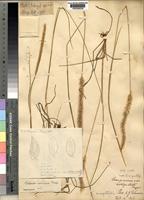
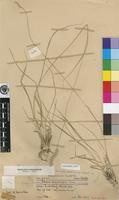
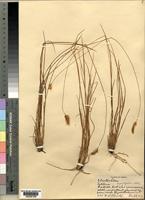
Perennial, densely tufted on a short oblique rhizome, about 2 ft. high; innovations intravaginal. Culms slender, erect, simple, 2- (very rarely 3-) noded, glabrous, more or less rough towards the inflorescence, otherwise smooth, lowest internode 1–3 in. long, long-exceeded by the basal sheaths, terete or slightly compressed, the intermediate 3–7 in. long, uppermost (peduncle) up to 1 1/2 ft. long and very long-exserted. Leaf-sheaths smooth, or the basal slightly pruinose, quite glabrous, rarely the lower appressedly or upwards spreadingly hirsute with white hairs, the outer basal very firm, brown, long-persistent without breaking up into fibres, 1–4 in. long, more or less compressed and keeled upwards, not flabellate, inner basal and those of the culms more or less herbaceous and the latter at least terete and tight with a slender upwards prominent keel-nerve; ligule truncate, short, densely ciliate; blade linear from an equally broad base, passing very gradually into the sheath, long-tapering to a setaceous point, from a few inches to up to 1 ft. long by 1–1 3/4 lin. wide, plicate in vernation, then opening out and often quite flat, rather firm, flexuous or when young sometimes more or less twisted, green, glabrous or more or less finely hirsute downwards with fine white hairs, rough upwards along the margins and nerves or sometimes all along, midrib and primary nerves (3–6 on each side) very slender, the latter close or more or less distant. Inflorescence a slender usually stiff dense continuous cylindric false spike, 3/4–3 (rarely 4) in. long by 2 1/2–3 lin. wide (exclusive of the bristles), fulvous; axis slender, terete, hardly sulcate, shortly tomentellous; branches reduced to sessile involucres supporting mostly a solitary, more rarely a cluster of 2 or even 3 spikelets of which only one is perfect, the others rudimentary; bristles fine, rather rigid, scaberulous, more or less unequal, 2 1/2–3 lin. long, about 8–12 to each involucre, whitish downwards; pedicels reduced to small stumps with discoid tips. Spikelets broadly elliptic-oblong in back view, semi-elliptic to semi-ovate in profile, subacute, rarely distinctly apiculate, 1 1/4–1 3/8 lin. long by over 1/2 lin. wide, glabrous, pale or variegated with dull purple. Glumes membranous; lower rotundate-ovate, subacute, up to over one-third the length of the spikelet, 3-nerved; upper similar, one-half to three-quarters the length of the spikelet, 5-nerved. Lower floret equalling the upper, ♂: valve corresponding in size and outline to the spikelet in front view, somewhat flattened and slightly depressed, 5-nerved; valvule as long as the valve, broadly elliptic, subacute, narrowly marginate; anthers 2/3 lin. long. Upper floret hermaphrodite, corresponding in outline to the spikelet in back view: the valve pale or the exposed part dark purplish or bluish-grey, like the valvule delicately transversely rugose, or the latter only punctate.