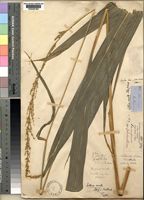
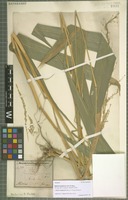
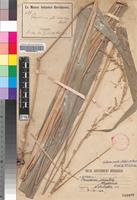
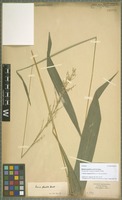
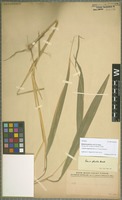
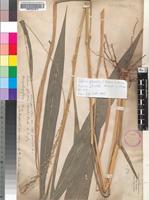
Perennial (?), base unknown. Culms erect, up to more than 5 1/2 ft. high, moderately stout, simple, more than 4-noded, sheathed high up, intermediate internodes more or less compressed, glabrous and smooth or sparingly hairy near the nodes, the uppermost internode (peduncle) terete, rough just beneath the inflorescence, long-exserted and up to 2 1/4 ft. long. Leaf-sheaths compressed and keeled, long, finely striate, firm, shortly hairy with deciduous hairs and rough from minute tubercles, bearded at the mouth, ciliate on the margins or the upper glabrous and smooth; ligule reduced to a densely ciliate rim; blade linear-lanceolate from a long attenuated base or there reduced to the midrib, tapering to a fine point, up to nearly 2 ft. long by about 1 1/4 in. wide, closely pleated towards the base, more or less flattening out upwards, firm but not rigid, ascending, glabrous, rough, midrib flat or shallowly channelled on the upper surface downwards, bluntly prominent beneath, primary lateral nerves numerous. Inflorescence a linear lax flexuous panicle, up to 1 1/4 ft. long and 1 in. wide; axis terete, striate, rough; branches suberect, slender, scaberulous, solitary or in clusters, the lower up to 3 in. long, distant by 1 1/2–2 1/2 in., the intermediate and upper mostly 1/2–2 in. long, all except the uppermost more or less divided near the base, and very sparingly so upwards, with short branchlets up to 5 lin. long, forming compound or upwards simple racemes of spikelets with most of the spikelets supported by a solitary bristle; bristles fine, flexuous, up to 5 lin. long, scaberulous; pedicels reduced to minute stumps with discoid tips. Spikelets lanceolate- to narrowly elliptic-oblong and acute in back view, semi-ovate-elliptic or semi-elliptic-oblong in profile, 1 3/4 lin. long by 3/4 lin. wide in back view. Glumes membranous; lower rotundate, one-third to half the length of the spikelet, 3–4-nerved; upper broadly ovate-elliptic, obtuse, half to two-thirds the length of the upper floret, 5-mostly 7-nerved. Lower floret barren: valve corresponding in outline to the spikelet as seen from the back, flat or slightly depressed on the back, 7-nerved; valvule about three-fourths the length of the valve, with narrowly winged keels. Upper floret hermaphrodite, as long as the lower, lanceolate- to elliptic-oblong and acute in back view: valve and valvule coriaceous, smooth or almost so.