JSTOR Global Plants Home
  • Home
  • Browse
  • About
  • Access
  • Account
    • Saved Items
    • Profile
  • Log in

Global Plants

Skip to Main Content
  • JSTOR Global Plants Home
  • Global Plants

    • Browse
    • About
    • Access
    • Account
      • Saved Items
      • Profile
Log in
  • Browse
  • About
  • Access
  • Account
    • Saved Items
    • Profile
Advanced Search

Compilation
Sesamum angolense

7 Images see all

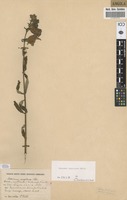
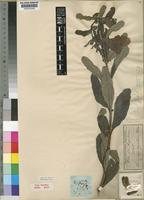
Filed as Sesamum angolense Welw. [family PEDALIACEAE]
Sesamum angolense Welw. [family PEDALIACEAE]
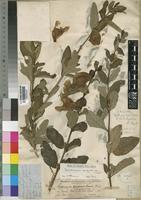
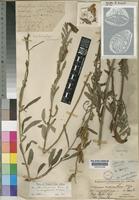
Isotype of Sesamum angolense Welw. [family PEDALIACEAE]
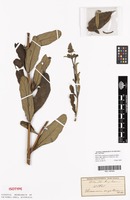
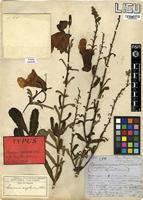
Type of Sesamum angolense Welw. [family PEDALIACEAE]
Sesamum angolense Welw. [family PEDALIACEAE]
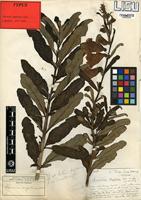
Type of Sesamum angolense Welw. [family PEDALIACEAE]
Previous
Next

Name

Identification
Sesamum angolense Welw. [family PEDALIACEAE ] (stored under name); Sesamum macranthum Oliver [family PEDALIACEAE ]
Related name
  • Sesamum angolense
  • Sesamum macranthum

Flora

Entry for SESAMUM angolense Welw. [family PEDALIACEAE]
Herbarium
Royal Botanic Gardens, Kew (K)
Collection
Flora of Tropical East Africa
Resource Type
Reference Sources
Entry From
Flora of Tropical East Africa, page 1, (1953) Author: A. BRUCE
Names
SESAMUM angolense Welw. [family PEDALIACEAE], Apont. Phyto-Geogr. 588 (1859); Trans. Linn. Soc. 27: 51 (1869); F.T.A. 4 (2): 555 (1906); P.O.A. C.: 365 (1895); W.F.K. 101 (1948), quoad descr. p.p., excl. fig. 81. Type: Angola, Pungo Andongo, Welwitsch 1645 (BM, holo.!, K, iso.!)
Sesamum macranthum Oliv. [family PEDALIACEAE], in Trans. Linn. Soc. 29: 131, t. 84 (1875). Type: Tanganyika, Usui, Speke & Grant (K, holo.!)
Sesamum macranthum Oliv. var.? angustifolium [family PEDALIACEAE], l.c. Type: Tanganyika, Uzaramo, Muhonyera, Speke & Grant (K, holo.!)
Information
Simple or branched, decorative, densely leafy, shrubby perennial herbs, 0.8–3 m. high; stems subquadrangular, sulcate, thinly pubescent. Leaves subsessile or shortly petiolate, generally discolorous, narrowly oblong, oblong-lanceolate or rarely elliptic, 2–11 cm. long, 0.4–4 cm. broad, margins entire more or less inrolled and scabrid, upper surface glabrescent, lower surface white tomentose, more sparsely so on older leaves so that the glands are visible, cuneate at the base, truncate, rounded emarginate, subacute (rarely acute) and usually apiculate at the apex. Flowers pink, red, purple, or pale mauve with deeper markings. Calyx usually persistent; lobes lanceolate or ovate-lanceolate, 5–10 mm. long, about 2 mm. broad at the base, acute or acuminate at the apex, pubescent. Corolla large, 3.5–7 cm. long, 2–3 cm. in diameter at the throat, thinly to densely pubescent. Filaments arising from a band of hairs near the base of the tube; anthers narrowly oblong, 6 mm. long. Ovary densely white-appressed-pilose, apex emarginate. Capsule subquadrangular, 4-sulcate, 2–2.5 rarely 3 cm. long, 5–6 mm. broad, rather densely pubescent, becoming glabrescent, gradually narrowed into a flattened rather broad beak up to 5 mm. long. Seeds not winged, about 2 mm. long, 1.5 mm. broad, faintly rugose on the sides and faces.
Range
DISTR. U4; K5; T1, 4, 68
Altitude range
3502300 m.
Distribution
KENYA N. Kavirondo District Kakamega (specimen cultivated at Nairobi), Jex-Blake in C.M. 6936!TANGANYIKA Bukoba District between Bukoba and Kyaka, Oct. 1940, Tweedie 543!;TANGANYIKA Mpanda District Ikuu, 22 Jan. 1950, Bullock 2311!;TANGANYIKA Iringa District Chiwanje, 18 Aug. 1933, Greenway 3575!UGANDA Masaka District Buddu, Kyebe, Aug. 1945, Purseglove 1784!
Distribution (external)
Belgian Congo
Nyasaland
Northern
Southern Rhodesia
Angola
Notes
This appears to be a fairly clear-cut species with large flowers and blunt leaves, which are white-tomentose on the lower surface. The species S. calycinum, mentioned under S. angustifolium, somewhat approaches S. angolense in its leaf-shape but differs in the smaller flowers and glabrescent or thinly pubescent leaves. The figure referred to this species in W.F.K. 101, t. 81, was in fact adapted from the Coryndon Museum painting of Bally 6071, which specimen is referred to S. latifolium.

Related Materials

  • Terms and Conditions
  • Privacy Policy
  • Cookie Policy
  • Cookie Settings
  • Accessibility
  • Help
  • Contact Us
  • Facebook
  • Twitter
ITHAKA

JSTOR is part of ITHAKA, a not-for-profit organization helping the academic community use digital technologies to preserve the scholarly record and to advance research and teaching in sustainable ways.

©2000-2026 ITHAKA. All Rights Reserved. JSTOR®, the JSTOR logo, JPASS®, Aluka®, and ITHAKA® are registered trademarks of ITHAKA.

╳